P167
Radioteletype
Radioteletype (RTTY)
Radioteletype, often referred to as ‘RTTY’, has been with us for a very long time. Certainly it is an automated digital mode, but it pre-dates the computer technology that drives today’s communications. As far as radio amateurs are concerned, it’s like text messaging a long time before mobile phones were common. RTTY is a very conversational mode. Certainly it may be used to exchange callsigns and signal reports, but RTTY is also a casual medium for exchanging, views and ideas. It is this simplicity which even today, makes it a very attractive mode.
The Baudot Code
RTTY uses a five bit code. This table shows every possible 5-bit combination presented as a 32 step binary sequence.

A 5-bit code is a pretty basic and has some inherent limitations. Thirty two combinations are enough to allocate one to each letter of the alphabet and still have six left over. This is fine until somebody want to encode a message with numeric information, as there is insufficient character space for the numbers 0 to 9.
Rather than upgrading to a 6-bit code (with its 64 combinations to choose from) a compromise was adopted where two 5-bit code tables were used. One table set had letters (upper case only) and the other set had numbers and some punctuation characters, such as brackets, commas and full stops. Two special shift-codes were used to select which of the two tables were presently ‘active’. These are called Letters Shift and Figures Shift, which is somewhat resembles the 123 and ABC character set shift on small screen phones and Dymo label makers. Encoding messages is slower because the operator must remember to precede groups of letters and numbers by the correct shift code, or the message becomes garbled.
The original Baudot code was devised in the early 1870’s by Emile Baudot. After a few revisions, the 5-bit Baudot character set looked like this:
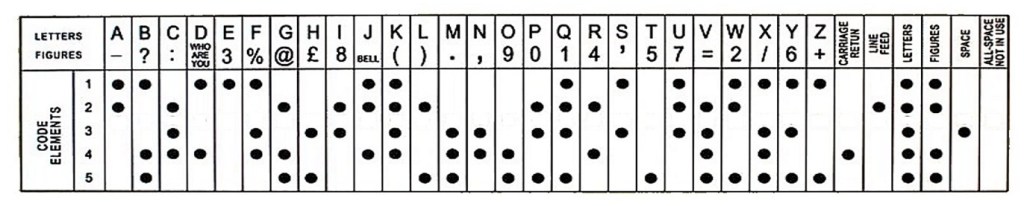
As shown, the bit combinations are shared between the Letters and Figures groups of characters.
These dot combinations are straightforward, but to be practical, there was a need for a reliable method of conveying those dot sequences over long distances. There is, and it’s called the Teleprinter.
Introducing the Teleprinter
The teleprinter is a mechanical contrivance that converting letters and numbers into the baudot code. It then sends this code down a long wire where it can be converted back to plain text. This technology was a breakthrough. Large blocks of text could be sent and
recorded without the need for specialist Morse Code skills. Indeed, the remote terminal could be completely unattended.
Although a 5-bit code is used, it’s not practical to have five separate wires travelling long distances to convey the status of each bit. The logical alternative is for all the combinations to be sent serially. Five time slots were reserved within each character that forced bits into one of two states called Mark and Space.

At the distant end, a receiving machine must perfectly synchronise with
this code to make sense of these binary combinations. The rate that these combinations were sent is measured in Bits-per-second, or ‘baud’. This word is a tribute to the aforementioned Emile Baudot, a term which is now firmly entrenched within our language.
MMTTY – PC based RTTY
Modern RTTY has evolved. Most operators use an excellent little program called MMTTY. It is an open-sourced application developed in 2000 by Makoto Mori JE3HHT of Osaka Japan. It attracted a huge following and many thousands of operators around the world have taken advantage of this free download. For details, visit:
https://hamsoft.ca/pages/mmtty.php
Importance of Duty Cycle awareness for FSK & AFSK Transmissions
One of the key aspects of Radioteletype for operators to be aware if is that it’s transmission requires a 100% duty cycle, which is to say that your radio is transmitting continuously. For this reason it is important to understand that transmitter power levels should be reduced by perhaps 30% to prevent unnecessary overheating of the transmitter.
Read the full QTC article on RTTY
To read the full story on radioteletype, visit the feature article in QTC in Winter 2020, available for download from the RASA website at: https://qtcmag.com/books/elbd/#p=22
ACMA Syllabus Extract
According to the ACMA Standard Syllabus, the required knowledge on this topic is:
5.5 Digital Transmissions
Recall that Morse code, Radio Teletype (RTTY), Frequency Shift Keying (FSK), Phase Shift Keying (PSK) and Packet radio are types of digital transmissions.
Recall that the bandwidth of a data transmission is dependent on the data transfer rate and the modulation type.
 This Is Amateur Radio