
P190
Basic Amateur Satellite Operation
Many people are unaware of the major influence Amateur Radio has had upon satellite technology.
Just as conventional repeaters exist on earth’s surface, there are hundreds of Amateur Radio satellites available for operators to listen to and at least ten of these are available for Amateurs to direct transmissions to as active radio repeaters.
The most common form of Amateur Satellite repeater is the ‘cubesat’. This is a standardised form factor for satellites based on a 100mm x 100mm x 100mm cube (1u size), small enough to fit in the hand.
Here is an example of the Norwegian Cube Satellite Ncube-2

It is common for universities to commission satellite projects. They often include a scientific payload on board, as well as a beacon, a repeater and a telemetry transmitter. The groups sponsoring these satellites track Amateur operator usage as it provides valuable data on performance of their satellite project.
In this example of the 1U CubeSat, the structure is small enough to be held in one hand

Put simply, we now have multiple satellites orbiting the earth with ham radio capability. Any suitably licensed Amateur operator can access these devices. Usually they are in the form of a VHF / UHF cross-band repeater where they receive on one band and re-transmit on a different band.
To the new operator, such activities may seem overwhelming, but using a satellite repeater at a basic level is no different to using an ordinary terrestrial repeater. Satellite repeaters have an input frequency, and output frequency, often requiring a CTCSS access tone to prevent accidental activation of the repeater.
For example, the International Space Station (ISS) has an FM cross band repeater with input @ 145.990 MHz and output on 437.800MHz. It requires a 67 Hertz CTCSS access tone to be sent by operators accessing the repeater.
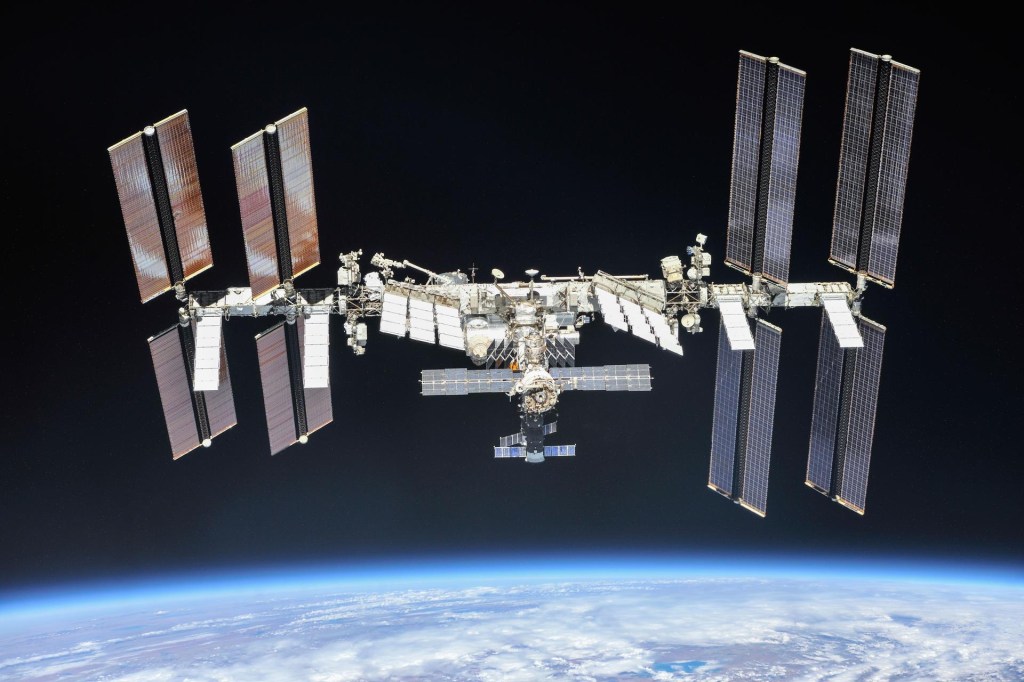
Unlike fixed repeaters on terrestrial hilltops, the distance, speed, moving nature and low power requirements of satellites do present complications.
Dealing with distance (and power)
Although the ISS does have a powerful transmitter, the smaller cubesats use power levels as low as 50mw on their downlink frequency. This requires the operator on earth to use of a high gain directional antenna that tracks the position of the ‘bird’. Such an antenna can be home built or purchased ready to use.
A popular purchase option is http://www.arrowantennas.com who make hand held antennas from aluminium arrow shafts.
Dealing with Speed
By way of example, the ISS moves at approximately 7.9km/s, that’s 8 times faster than a bullet fired from a rifle. Like the Doppler Shift effect of sound emanating from a moving train, this high satellite speed causes radio waves to be compressed when it approaches a terrestrial position, hence signals from ground stations reach the satellite on a higher frequency than what was transmitted. The opposite effect applies when a satellite is moving away from a ground station position and signals arrive on a lower frequency. It is up to the ground station to manually compensate for this Doppler shift effect upon satellite approach and departure.
This adjustment can be made by preparing 3 or 5 memory positions on the operator’s radio with a range of shifted frequencies, then step through these memories as the satellite passes over.
This table shows a typical stored memory set for a satellite on 437.800 MHz

Dealing with Satellite movements
Low Earth Orbit satellites only cover a small portion of the planet surface and move at a great speed. Operators will need to make use of a dedicated satellite website or tracking software to know when any given satellite is within range.
Here is a typical satellite tracking website:
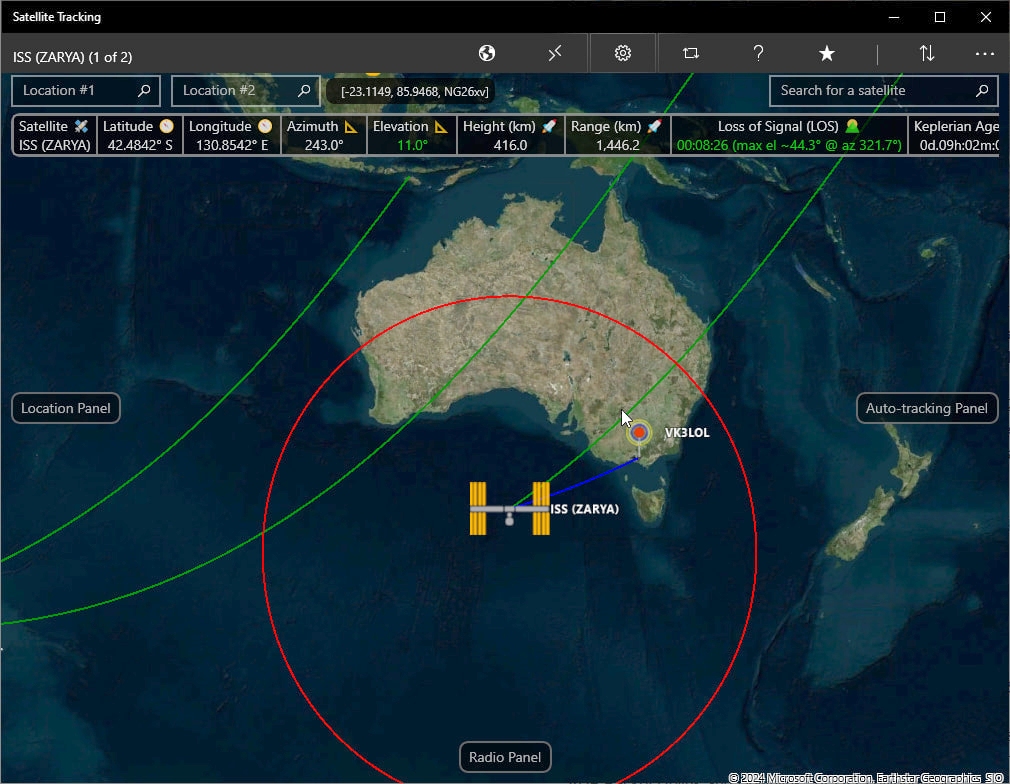
This software simply called ‘Satellite tracking’. It is in the windows store and work well with most modern radios. In this example we are seeing a pass of the ISS over Australia with blue line representing bearing from operators’ location, red circle showing the line-of-sight coverage and green line showing direction of travel.
With advance knowledge of where the satellite is going to be at the beginning, middle and end of pass, in conjunction with careful timing, operators can mentally draw an arc through these nodes and point their antenna in the appropriate direction. Any low-cost VKF/UHF portable radio with factory antenna held broadside to the arc is capable of receiving signals from the ISS.
Here are typical steps an operator would take to follow signals from the space station.
Step 1
Look up the upcoming passes via the link – https://www.amsat.org/track/index.php
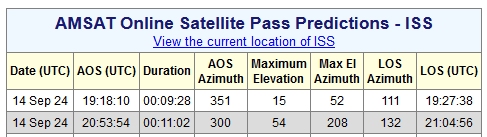
In this example, at 20:53:54 UTC (adjust to your local time as required) we have a pass that peaks at 54 degrees elevation mid pass. This is a good candidate for tracking.
Step 2
Identify and observe a landmark at for the beginning of the pass at 300 degrees from your location, another at 208 degrees and finally one at 132 degrees. Picture a point 54 degrees above the horizon at your middle point. Next draw an imaginary line from the first point, through the mid-point in the sky and then to the last point.
Step 3
You will now point your antenna at the Acquisition Of Signal (AOS) point and listen at the AOS time for the satellite to arrive. Mentally visualise the satellite movement on its arc in the sky as the and try to follow it. As it passes change frequencies to keep up with Doppler shift.
With some practice and patience (not everyone is talking on every pass) you will hear many stations hams talking on the ISS repeater.
The golden rule for ‘working the birds’ is to Refine your setup and operating technique with reception only before attempting to transmit into the satellite.
Operators must take care to listen before transmitting to ensure that they are not interfering with the efforts of other operators to access a satellite.
Some Common Satellite Terms
- AoS – Acquisition of Sight
- LoS – Loss of Sight
- Azimuth –
- Elevation –
- UTC – Universal Time Coordinated
- LEO – Low Earth Orbit
- ISS – International Space Station
- ARISS – Amateur Radio on the International Space Station
- OSCAR – Orbiting Satellite Containing Amateur Radio
- Bird – Common nickname for amateur cube sats
- Doppler shift – The change in frequency of an audio or radio wave as it moves toward or away from the observer
Some Useful links
 This Is Amateur Radio