P191
Solar/Space Weather Tracking
Long distance communications on HF is only possible via our planetary ionospheric layers. This in turn is entirely dependent upon reactions of radiations from our sun. It makes sense to track the conditions on the surface of the sun if we want to maximise our communications range. These solar variations are popularly known as ‘Space Weather’
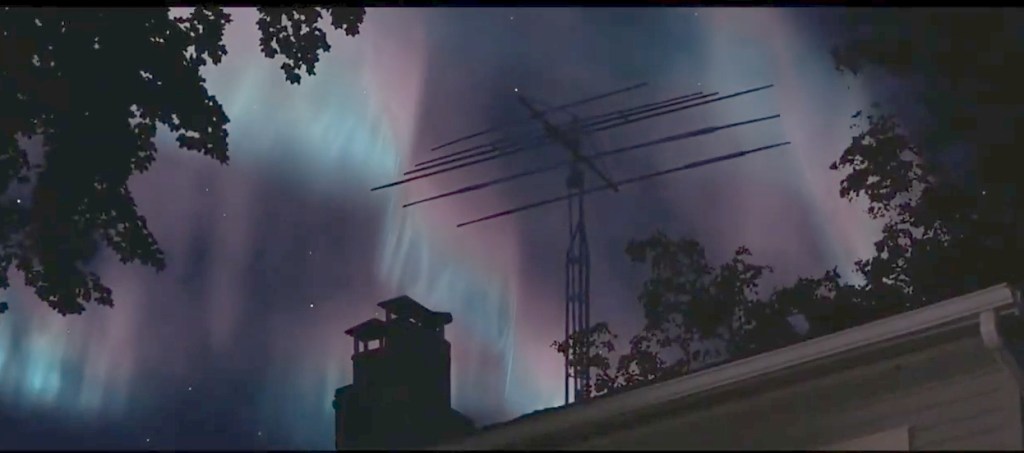
Solar activity directly affects ionospheric structure and density in ways that can either enhance or shut down communications between different parts of our planetary surface.
As an Amateur Radio operator, you can experience the effects of Solar Weather firsthand. When the ionosphere is disturbed, it causes blackouts of high-frequency (HF) radio signals. The increased ionisation density can absorb radio signals, especially on lower bands. However, the ionospheric disturbances often lead to enhanced propagation on VHF and higher bands via mechanisms like sporadic E propagation.
While frustrating at times, solar activity also creates opportunities to make rare long-distance contacts. During and after solar storms, band conditions can change quickly. Frequencies that were dead one minute can suddenly open up for contacts over vast distances.
When the peak of a Solar disturbance has passed, it is possible to work stations over very long distances on 6 or 10 metre bands. The key is to keep scanning the bands to discover these fleeting propagation paths, or monitor DX trend websites like the Reverse Beacon (RBN) Network.
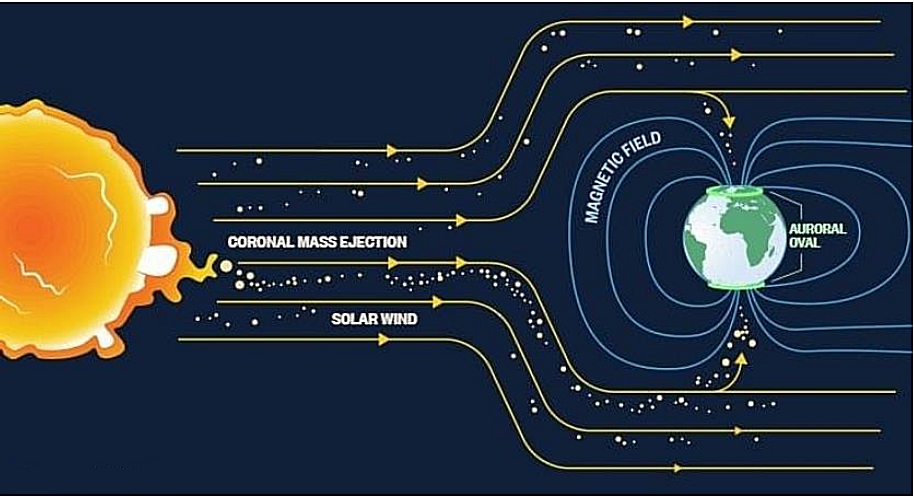
X-class solar flares are often accompanied by geomagnetic storms, caused by coronal mass ejections hitting Earth’s magnetic field. During solar storms, the ionosphere becomes highly unstable. HF signals that normally bounce off the ionosphere can get absorbed or take wild detours. These storms further disrupt the ionosphere and can damage power grids. With the ionosphere hopping all over the place, solar storms turn into a real-world HF propagation experiment.
Charged particles from the sun would be very damaging to life on earth if it were not for the powerful magnetic field that surrounds our planet. The interactions that take place between that field and coronal mass ejections are complex and chaotic, so although predictions about effects can be made, the actual outcomes are always going to be variable.
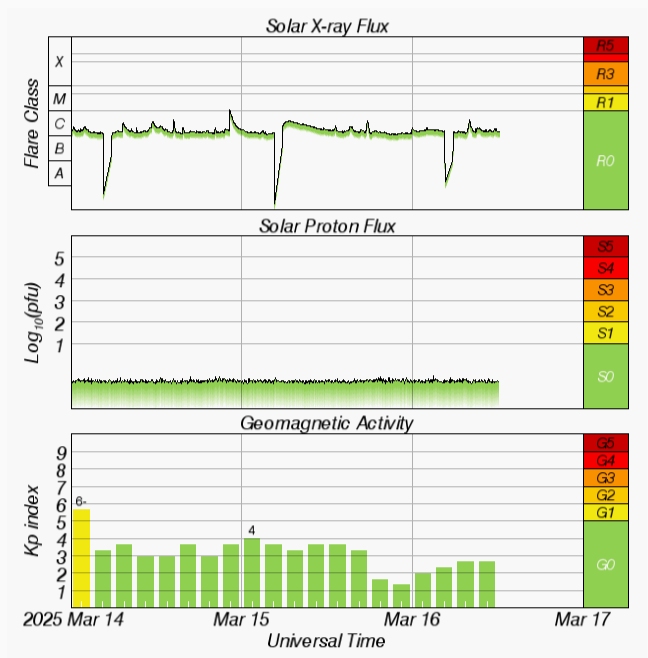
There are three main indicators that are tracked from the sun. Solar X-ray Flux, Solar Proton Flux and Geo-Magnetic activity. These charts were taken from the VK3FS website on space weather: https://3fs.net.au/space-weather/ They can also indicate the presence of aurora’s at the earth’s poles.
Looking for Sunspots
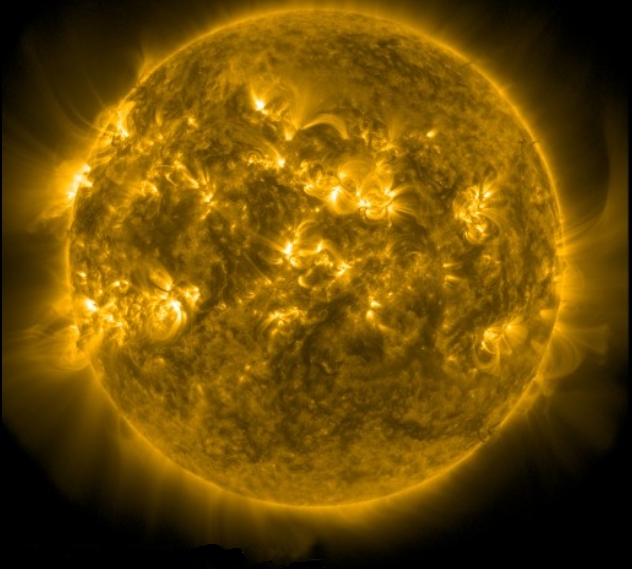
Sunspots are dark, planet-size regions of strong magnetic fields on the surface of the sun. They can spawn eruptive disturbances such as solar flares and coronal mass ejections (CMEs).
The Australian Bureau of Meteorology suggests one method of observing sunspots by using a pair of binoculars, not by looking through them but by using the binoculars to focus an image of the sun onto a piece of paper located in the shade
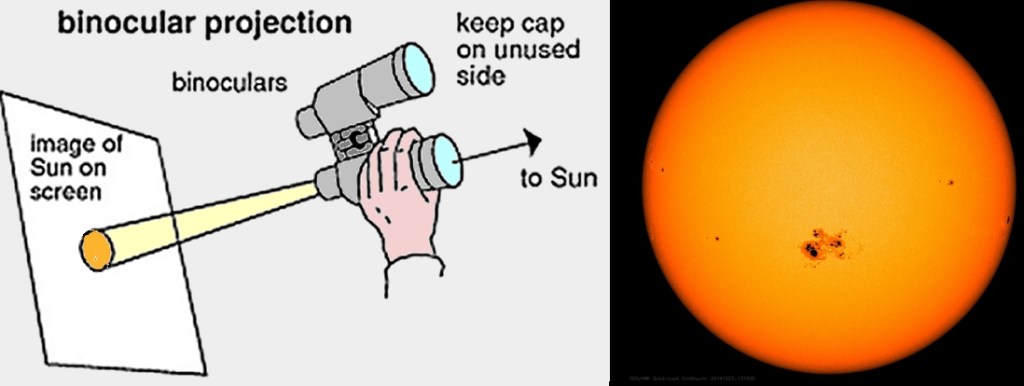
These regions of the sun appear darker because they are cooler than their surroundings. The central dark region, the umbra, is about 6,300 degrees Fahrenheit (3,500 degrees Celsius), whereas the surrounding photosphere is about 10,000 F (5,500 C)
The frequency and intensity of sunspots visible on the surface indicate the level of solar activity during the 11-year solar cycle that is driven by the sun’s magnetic field. Sunspots are our window into the sun’s complicated magnetic interior.
The Carrington Event
In 1859 there was a large Coronal Mass ejection from the sun and the earth passed through this solar storm. It played major havoc with many electrical and telegraph systems. It was known as the Carrington Event. If it happened again today there would be major damage to international communications networks.
You can read about this event at: https://www.space.com/the-carrington-event
Where to track Solar Weather Events.
The Australian Bureau of Meteorology has a comprehensive Space Weather website. It can warn and report upon geomagnetic storms. https://www.sws.bom.gov.au/
An international site reporting on space weather is Space Weather Live, located at: https://www.spaceweatherlive.com/
More reporting with specific detail of interest for Amateur Radio operators may be found at the VK3FS website: https://3fs.net.au/
Further good Reading:
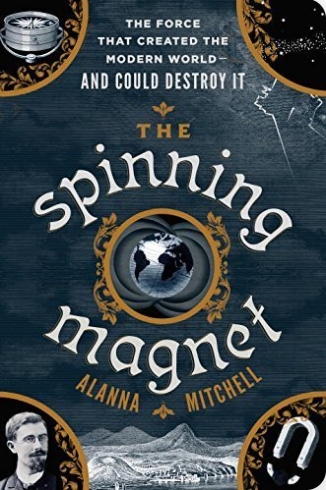
The Spinning Magnet by Alanna Mitchell details the history of electronics from a unique perspective and the extraordinary history of the discovery of earth’s magnetic field.
https://www.goodreads.com/book/show/35754738-the-spinning-magnet
 This Is Amateur Radio