
P199
Tower & Mast Installations
What makes a Tower?
An important part of any Amateur Radio installation is the antennas and the structures that support them. There is no correct answer to this, as a support structure can be as simple as a conduit cable tied to a roof vent or a guyed multi-stage radio tower. The limitations are funding, available space and whatever the local council will let you get away with.

It should be clear at the outset that while this page describes various types of installation, that clambering around rooftops and latticework has inherent dangers and nobody should be carrying out mast and tower work without sufficient confidence, fitness, skill, safety equipment and at least one observer on hand.
Mobile and temporary field antennas are not covered in detail here, as for temporary installations, the operator can stand them up in good weather, and take them down before storms come in. Still, under field conditions, operators can be creative. In this instance the UHF vertical uses a wheel brace for a ground plane and the mast is three sticks and some electrical tape.

Starting Small
At home, modest antenna installation may only require a section of pole tied to the gutter of a rooftop. How far this is taken depends upon allowances for the wind. Wire antennas have low wind loading and worst case, if they come down they just make a tangle on the ground. Guy ropes can provide a lot of support, but they also take up a lot of space. Here we can see two 6 metres sections of PVC pipe guyed, to be used for the end of a wire antenna or for a vertical antenna. A cheap and simple option, fine for mild weather and light winds, but vulnerable in gusts over 80 kph.

What do I need?
Certainly, the bigger they are, the harder they fall. Larger antennas are going to require robust support structures and stronger guy ropes. An important consideration is always going to be safe clearance from power line infrastructure. No mast or tower should be erected where any problems with the antenna, or anyone working on the antenna will come within reach of power lines. Particularly high voltage lines which can arc for several metres under the right conditions.
Directional, Rotatable installations.
If a decision is made to erect a HF beam, it is also going to require a method of rotation. This means larger antennas and more weight. A low cost, modest installation can consist of steel waterpipe 50-60mm diameter and guy ropes. This image shows a small antenna rotator mounted on a single section of waterpipe, with a 1 metre protrusion above the rotator to mount a dual-band HF beam.

Unfortunately, most modern homes are built close to the property boundaries. This means that masts erected around the edge of the home are going to have antenna elements that overhang neighbour’s land. To get around this problem, shorter beam antennas and mid-roof mounts can resolve this dilemma.
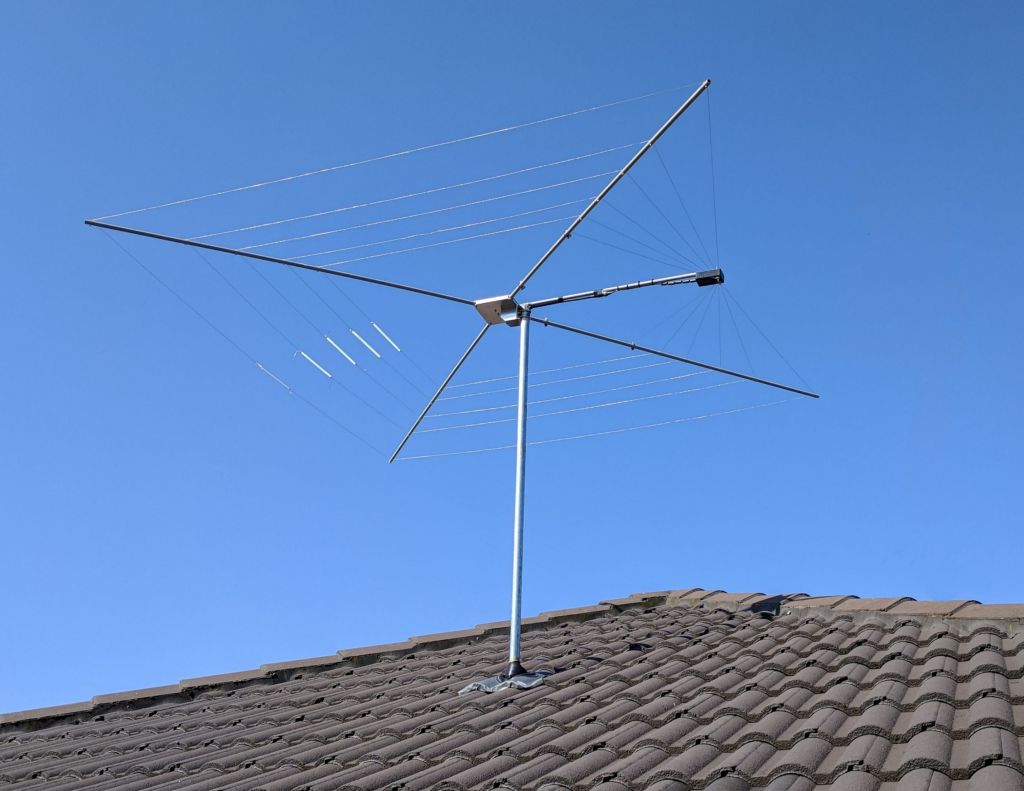
For a fixed beam like this omnidirectional HF Cobweb antenna, as section of pipe was bolted to the rafters under the tiles. It is an unobtrusive option in conditions where a larger antenna could be prohibited.
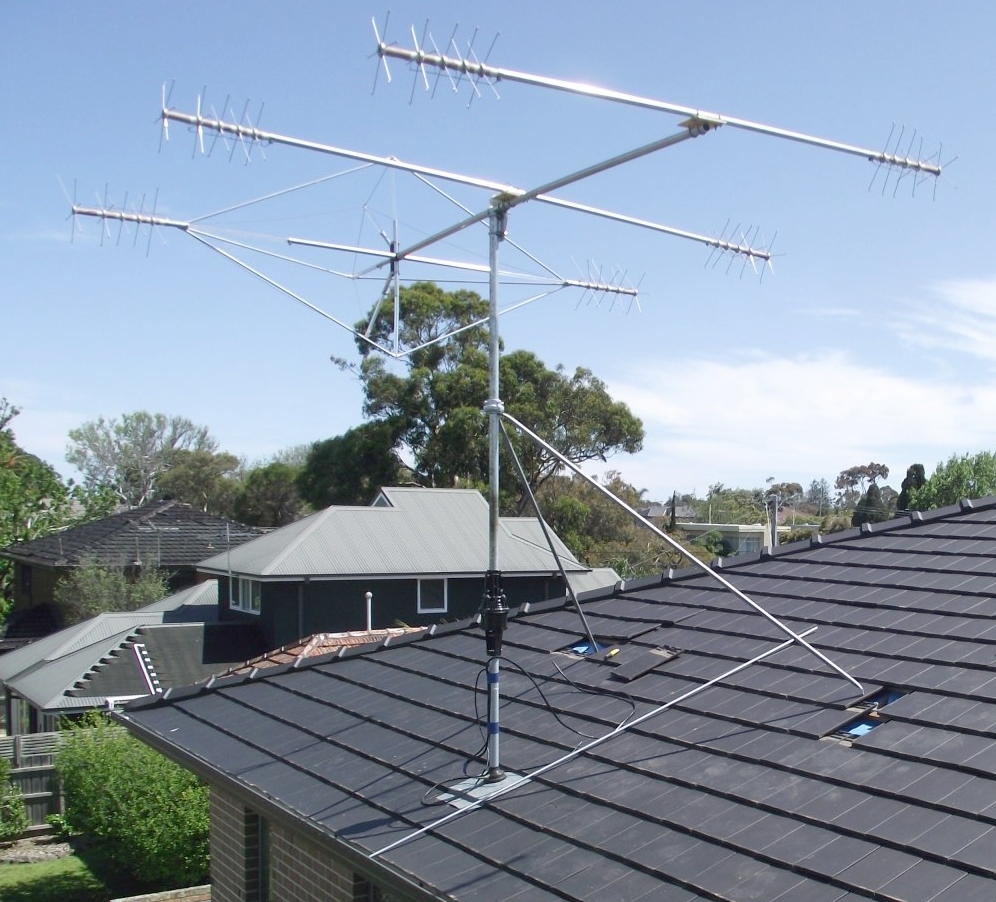
A variation on this allows for an antenna rotator arrangement. A swivel bearing has been mounted above the rotator, with rigid straps that tie back to flat plates which pass under the lower edges of the roof tiles. Standard plumbing flanges and gaskets can ensure waterproof seals around support pipes.
Free-standing windmill towers
There were a lot of these triangular lattice towers in circulation as many were used for TV antennas in rural areas. On the plus side, they can be purchased for low price and don’t require guy ropes, but they also can be difficult to install as someone must climb the tower and perform the fitout precariously in the air. Maintenance of any kind can become a big deal down the track. Not a good option for anyone with limited agility. In modern urban areas where council approval is being sought, sticking points can be the lack of documentation, lack of computations and a requirement of proof of structural integrity. Older towers purchased at a low price may not meet this criteria.

The Tiltover Tower.
In the 1970’s a Melbourne based company called Nally began manufacturing tiltover towers for commercial and Amateur applications. These were an excellent option for enthusiasts. For the next 30 years these towers were prolific around the country, with many being erected at rural police stations. Hundreds are still in service today.
They are a heavy duty two-stage structure with latticework 13.7 metres high, just under a 14 metre planning threshold. Rated for cyclonic conditions, these would support large antennas and required no guy ropes. Often a 6 metre length of scaffolding pipe would protrude from an antenna rotator near the top.

The big advantage was they could be telescoped to half-height, then tilted over in cramped spaces, allowing antennas to be added and serviced from close to ground level. The foundation was typically a single 150mm pole, buried around 2 metres into the ground in concrete. Often when a property was sold and the tower would need to be relocated, the pole would be cut off at ground level, a new section of pipe would be added and sleeved, then the tower could be planted at a new site (See the link at the end of the page on Nally Tower Relocation processes.)

Buy it or build it?
The short answer is that it is always going to be cheaper to buy a secondhand tower and re-fit it than to build one from scratch. Construction is slow and steel can be expensive. Yes you can make your own, but fabrication of this scale requires a significant skill set. The end result must also be painted or (better) hot-dipped galvanised for rust protection.

Winches
Early two-stage towers would employ a hand winch to elevate the second stage. This was fine, but the primitive pawl and ratchet winches that were standard with early Nally towers were somewhat dangerous for the operator. One slip and the handle would whiz around and break the arm of the operator. The fix for this was to grind off the original winches and replace them with more modern Brake-Winches. These have a mechanical advantage and the operator can stop at any time – without resulting in a runaway winch handle and a top stage that turns into a pile driver. An article titled ‘The Wicked Winch of the East’ which detailed the winch upgrade process appeared in the GGREC magazine in 2006 on Page 13. http://ggrec.org.au/Magazines/200608.pdf

Counterweights for tiltover towers
With tiltover towers, the initial movement is usually easy because of weight distribution, but as the tower approaches horizontal, the weight on the winch and winch operator increases. This is particularly noticeable if the tower is fitted with large antennas. One way to alleviate this problem is to place a counterweight of some kind on the base of the tilting tower. This is sometimes a bucket of scrap metal on a 1 metre chain, or as seen in the image below, a slab of steel and a hook arrangement will suffice. Counterweights can make tilt over tower service work much easier for the owner.

Tower Permissions.
A topic to be addressed here are the traps that may be encountered when trying to get permission to erect a mast or tower. Rental properties are problematic because the landlord or owner have complete control over what can be installed or not. Usually a modest vertical antenna that does not structurally impact the property is ok – provided it does not attract complaints. Where a person may notionally own a property themselves, but it is under Strata Title arrangements, then the committee of management can override personal preferences. Some estates have been established with specific caveats attached to the land title preventing any antennas being erected, although some of these requirements are not actually enforceable in law. The most common situation is that a person may attach an antenna to the side of a dwelling up to 8 metres in height, without having to seek permission. Under most Australian state laws Towers up to 14 metres may be permitted without planning permission, only requiring building structural permission, but some councils choose to fight these limitations with tricks. They have been known to declare all Amateur Radio towers to be Telecommunications towers, where town planning requirements still apply. There have been several cases placed before civil tribunals to challenge these assertions and often councils have lost, but it is a slow and expensive process.
An important distinction for Amateurs to be aware of is separation between the mast structure and the antenna. Councils may try to deem them to be a single structure and apply height and construction codes to both. The position that an Amateur should take is to seek permissions for the mast/tower only, as the antennas placed on it are experimental and variable and may be changed at any time.
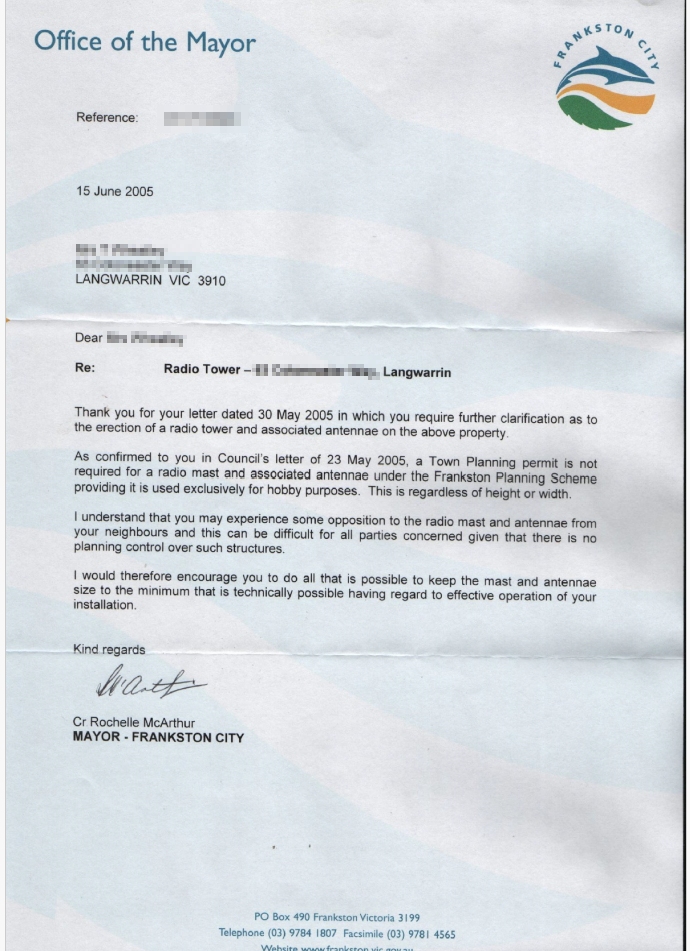
It is not all bad news. Sometimes council officials can be quite accommodating, as can be seen in this letter from the mayor of Frankston council.
Anyone having problems with tower permissions should consult widely with other Amateurs in their area and find out what precedents can be applied from other successful installations. A strategy by one operator was to model their mast on the flag pole out the front of the council offices in their area, on the basis that the council can’t argue that it is unsafe.
Getting power up to the tower
There is a bit of work in the preparation of tower cabling, getting past the rotatable sections, placement of cables underground or overhead and the selection of cable types. An article dedicated to this topic can be found in the October 2025 QTC magazine via this link: https://qtcmag.com/books/gymk/#p=18
Grounding of towers
Generally, towers should be grounded with heavy cable attached to an earth stake. The logic being that if the tower is struck by lightning, that the best current path to earth is not via the coax cable into the house and through an expensive transceiver. Grounding a tower can also help reduce local noise levels, as a ‘floating’ mast can act as a receive antenna for noise that then couples into your receiver.
Extra tips.
Ensure that water can’t pool around the base of a mast or tower, as this can lead to rust that will destroy structural integrity. Coax and rotator cables should have a loop before entering a home, otherwise rain can track down cable runs into a home. Where rotatable antennas are used, good clearance is needed with cables that bridge the rotator so that they don’t snag at limits of rotation. Check out the separate page dedicated to Antenna Rotators for more information.
Nally Tower Tower relocation article:
https://ggrec.org.au/Magazines/Downloads/Articles%20of%20Interest/Nally_Relocation.pdf
Nally Tower relocation video by VK3CSJ
Installation tips for tower installations – a useful You Tube video:
 This Is Amateur Radio