P2
ACMA recognition certificate (Standard)
Syllabus and examination information
FEBRUARY 2024
The ACMA recognition certificate (Standard) qualification for amateur radio in Australia.
It allows people to operate an amateur station on a limited set of frequencies and power output levels.
The syllabus and related examination for the ACMA Standard recognition certificate reflects an intermediate level of knowledge, skills and experience required to:
- safely assemble an amateur station
- operate it safely on the Standard certificate frequencies
- not cause interference to other users and services.
Follow the operating conditions set out in:
- The Radiocommunications (Amateur Stations) Class Licence 2023 (known as the Amateur Class Licence)
- The Determination 2015 (known as the Amateur LCD) – for beacon or repeater station operation.
- The Radiocommunications Act 1992.
Examination Notes:
- Examination candidates will be supplied with reference materials to facilitate some of the assessment requirements. Materials may include look-up tables, formulas, diagrams, photographs, relevant class licences or licence condition determinations, and physical examples.
- Recall indicates the requirement to recall a fact and apply it directly to the assessment question or situation. This may include using the supplied reference material.
- Understand indicates the need for more detailed knowledge of the subject.
- Demonstrate indicates that the candidate is required to carry out a physical task.
- Identify indicates that the candidate is required to identify particular objects, diagrams or other matters from a supplied set.
- Reference to a ‘transceiver’ means a combined transmitter and receiver.
- Reference to ‘harmful interference’ means as defined in the Australian Radiofrequency Spectrum Plan.
The Syllabus in Detail (Standard Qualification)
1.1 Nature of Amateur Radio
Recall that amateur radio is intended to facilitate the hobby of radiocommunications
1.2 Types of Licenses
Recall that amateur radio activities are authorised under the Amateur Class Licence and the Amateur LCD for beacon and repeater stations. Other forms of licences authorise different types of radiocommunications, such as citizens band (CB), land mobile, point-to-point links and broadcasting.
1.3 Allocation of Frequency Bands
Recall that the amateur service operates on frequency bands allocated for amateur use.
Recall that the amateur service shares some frequency bands with other services.
Recall that services, such as broadcasting, aeronautical and maritime services, are allocated frequency bands appropriate to their purpose.
2.1 Permitted Power Output
Recall the maximum transmitter output power permitted under the Amateur Class Licence.
2.1 Amateur conditions
Recall that operation of an amateur station is subject to conditions in the Radiocommunications Act 1992, the Amateur Class Licence and the Amateur LCD for beacon and repeater stations.
2.2 Purpose of the amateur service
Recall that the Amateur Class Licence primarily authorises the operation of an amateur station for self-training in radiocommunications, intercommunication between amateurs and technical investigations into radiocommunications.
2.3 Communications by amateur stations
Recall that, except in relation to a distress or emergency situation, or participating in emergency services operations or training exercises, the Amateur Class Licence only authorises amateur-to-amateur communications.
2.4 Third Party Operation
Recall that particular conditions apply to the transmission of messages on behalf of a third party or messages to amateurs in another country.
2.5 Distress and urgency signals
Recall that distress communications are signalled by the use of ‘MAYDAY’ and that these communications have priority over all other communications.
Recall that anyone hearing a ‘MAYDAY’ communication is responsible for passing the information on to an appropriate authority.
Recall that some urgent situations not warranting the use of ‘MAYDAY’ are signalled by the use of ‘PAN-PAN’.
Recall that these communications should receive priority and should be reported to an appropriate authority.
2.6 Station identification
Recall that correct station identification is required at the beginning and end of a transmission and at least every 10 minutes during transmissions.
Recall that any transmission, even a test transmission, must contain station identification.
2.7 Amateur call signs
Identify the categories of call signs used in the Australian amateur service. Identify call sign suffixes applicable to each licence category, call sign prefixes and state designators.
2.8 Secret messages
Recall that the transmission of secret coded or encrypted messages is generally not permitted.
2.9 Authorised frequency bands and emissions
Recall that the Amateur Class Licence authorises operation on certain frequency bands and the use of certain emission modes. Recall in which document the bands and modes are specified.
2.10 Permitted power output
Recall the maximum transmitter output power permitted under the Amateur Class Licence.
2.11 Notification of change of contact details
Recall that an operator should notify the Australian Communications and Media Authority (ACMA) of any change of contact details.
2.12 Harmful interference
Recall that a person must not operate an amateur station if operation causes harmful interference to other licenced services.
2.13 Use of amateur stations
Recall that only people with suitable qualifications may operate a station.
2.14 Who may operate a Station
Recall that a person without amateur qualifications may communicate via an amateur station provided the station is always under the full control of a qualified person.
2.15 Use of a station by non-qualified persons
Recall that an amateur station cannot be used for financial gain or reward.
2.16 The ACMA may obtain information or documents
Recall that the ACMA has the power to request information from an amateur, including evidence of their qualification.
2.17 Restriction of operation to avoid interference
Recall that the ACMA has the right to restrict the operation of an amateur station to avoid harmful interference
2.18 Use of the Amateur Class Licence and Amateur Class LCD
Recall specific licence conditions from the Amateur Class Licence and Amateur LCD for operating an amateur station.
3.1 Mathematics
Understand addition, subtraction, multiplication and division.
Understand fractions, percentage, and decimal notation.
Recall units and sub-units (mega, kilo, UNIT, micro, and pico).
Understand how to calculate using simple formulae.
4.1 Mains power
Recall the voltage and frequency of the mains supply used in Australia.
Recall the voltages and relationship between the single phase Active, Neutral and Earth.
Recall the colour code of mains wiring.
Understand the reason for the Earth connection (if provided) on mains operated equipment.
Recall the purpose of a fuse and switch in the Active lead of mains operated equipment.
4.2 Mains Power Supplies
Recall the different types of rectifier and smoothing circuits (i.e., half wave, full wave and bridge).
4.3 Maximum Rectifier Voltage
Understand the need for rectifier diodes to have a sufficient peak inverse voltage (PIV) rating.
4.4 Voltage and Current
Understand the meaning of voltage, electrical pressure, electromotive force and potential difference.
Understand the meaning of electrical current.
4.5 Resistance
Understand the meaning of electrical resistance.
Calculate the total value of resistors used in series, parallel and series-parallel combinations.
Note: Calculations will only involve resistors of the same value.
4.6 Resistor colour code
Identify the value of a resistor using the resistor colour code.
4.7 Ohms law
Understand the relationship between voltage, current and resistance.
4.8 Power in DC circuits
Understand how to calculate the power in a DC circuit using current and voltage, current and resistance or voltage and resistance.
4.9 Capacitance
Recall that the unit of capacitance is the Farad.
Recall that capacitor consists of two conducting surfaces separated by an insulator.
Recall that the capacitance of a capacitor is influenced by the area and separation of the plates and the type of the insulator between the plates.
4.10 Capacitor Usage
Understand that capacitors have a breakdown voltage and that they need to be used within that voltage.
Recall that some capacitors are polarised and must be correctly connected.
4.11 Capacitor Charge Danger
Recall the dangers of stored charges on large or high voltage capacitors.
4.12 Capacitor Formulas
Understand and apply the formulae for calculating the combined values of capacitors in series, parallel and series-parallel combinations.
Note: Calculations will only involve capacitors of the same value.
4.13 Inductance
Recall that the unit of inductance is the Henry.
Recall that an inductor is normally a coil formed by a number of turns of wire.
Recall that an inductor is able to store energy in its magnetic field. The ability of an inductor to store and use that stored energy is known as inductance.
4.14 Inductor usage
Recall that the inductance of a coil increases with increasing number of turns, increasing coil diameter and decreasing spacing between turns.
4.15 Inductor Formulas
Understand and apply the formulae for calculating the combined values of inductors in series, parallel and series-parallel combinations.
Note: Calculations will only involve inductors of the same value.
4.16 AC Circuits
Understand that the root mean square (RMS) value of a sine wave has the same heating effect as a direct current of the same value and that it is equal to 0·707 of its peak value.
4.17 Sine Wave intervals
Recall that the period (time) of a sine wave is equal to 1/f seconds and that the frequency of a sine wave is equal to 1/T (where f = frequency in Hertz and T = time in seconds).
4.18 The AC Cycle
Understand that AC waveforms are expressed in degrees and that a complete cycle is equal to 360 degrees.
4.19 Impedance and Reactance
Recall that the term ‘reactance’ describes the opposition to current flow in a purely inductive or capacitive circuit.
4.20 Definition of Impedance
Recall that impedance is the total opposition to current flow in an AC circuit.
4.21 Tuned Circuits
Recall that at resonance XL = XC and that the impedance is resistive.
4.22 Quality Factor
Recall that the Q factor is an indicator of the amount of losses in a tuned circuit.
4.23 Series/Parallel Tuned Circuits
Recall the impedance of series and parallel tuned circuits at resonance.
4.24 Transformers
Recall that a transformer usually consists of two or more coils of wire which are mutually coupled by a common magnetic field. A transformer may have a core material to increase the mutual coupling of the magnetic field.
Recall Faraday’s law of induction: ‘When relative motion exists between a conductor and a magnetic field a voltage is induced into the conductor.’
4.25 Transformer Turns Ratio
Recall the relationship between the voltage ratio and turns ratio and current ratio of a transformer.
4.26 Transformer Eddy Currents
Recall the cause and effects of eddy currents and the need for laminations (or ferrites) in transformers.
4.27 Solid State Devices
Recall the forward voltage drop across typical semiconductor diodes.
4.28 Zener Diode Usage
Recall that a Zener diode can be used as a voltage regulator.
4.29 Varactor (Varicap) Diode Usage
Recall that the varactor (varicap) diode behaves as a voltage variable capacitor.
4.30 Transistor and FET Symbols
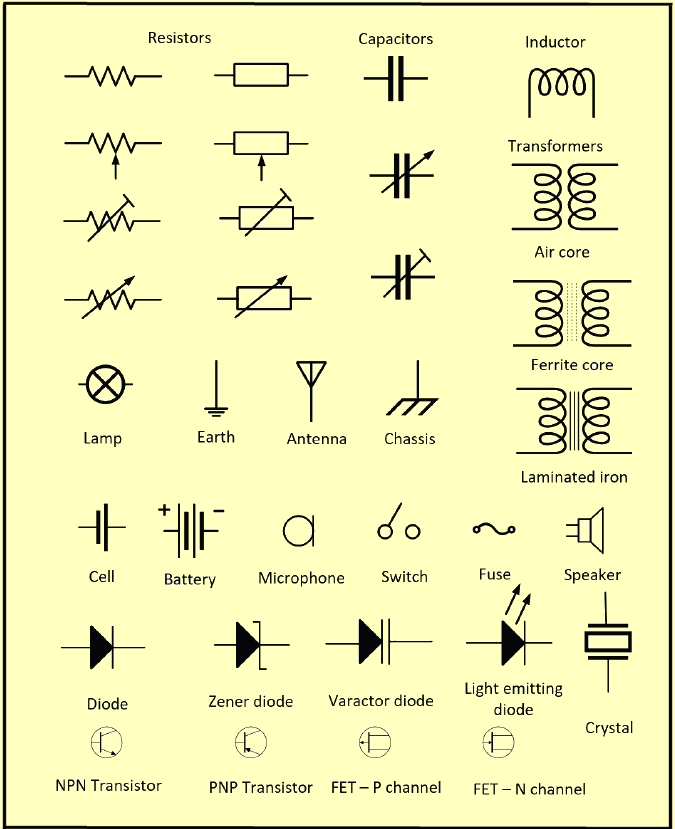
Identify the symbols of NPN and PNP transistors and the Field Effect Transistor (FET).
4.31 Transistor Operation
Recall the basic external operational characteristics of NPN and PNP transistors and field effect transistors (FETs).
Identify NPN or PNP transistors or a field effect transistor used in a common-emitter or common-source configuration.
Note: Candidates are not required to have knowledge of the internal workings of a transistor. Questions about transistor circuits will be simple and limited to common emitter or common source configurations.
5.1 Block Diagrams of Simple Transmitters
Identify the stages of a simple amplitude modulation (AM), single sideband (SSB) transmitter.
Identify the stages of a simple frequency modulation (FM) transmitter.
Note: The questions may involve a power supply, audio input stage, carrier oscillator, variable frequency oscillator (VFO), mixer (frequency converter), frequency multipliers, modulators, output amplifiers and output filters.
5.2 Mixers
Understand that mixers can be used to convert a signal on one frequency to another frequency.
Understand that the mixing process also produces unwanted frequencies that must (usually) be filtered out.
5.3 Modulation
Recall the meaning of the term peak deviation as it applies to frequency modulation.
Recall the meaning of depth of modulation as it applies to amplitude modulation.
5.4 Principles of AM FM SSB
Understand the basic principles of AM single sideband (SSB), AM double sideband (DSB) and FM modulators.
Recall the relationship between the modulating audio and AM and FM output signals.
Recall the advantages and disadvantages of AM (SSB) and FM signals.
5.5 Basic Digital Transmissions
Recall that Morse code, Radio Teletype (RTTY), Frequency Shift Keying (FSK), Phase Shift Keying (PSK) and Packet radio are types of digital transmissions.
Recall that the bandwidth of a data transmission is dependent on the data transfer rate and the modulation type.
5.6 Amplifiers
Understand the meaning of the terms ‘linear’ and ‘non-linear’ in relation to amplifiers.
Understand the need for linear amplification and recall which forms of modulation require a linear amplifier.
Determine the efficiency of an amplifier given the DC input power and the RF output power.
5.7 Effect of Modulation on Transmitted Power
Understand the implications of the different types of modulation on the rated output power of a power amplifier (PA).
Understand the term ‘duty cycle’ in relation to transmitters.
5.8 Automatic level Control (ALC)
Recall the basic function of automatic level control (ALC) in a transmitter.
Recall the function and use of a manual radio frequency (RF) power control.
5.9 Transmission Quality
Recall the effects of frequency drift and the importance of its minimisation.
5.10 Unwanted Emissions
Recall that transmitters may radiate unwanted emissions such as harmonics and other spurious signals.
Recall the use of low and band pass filters in minimising the radiation of unwanted emissions.
5.11 Parasitic Oscillation Effects
Recall the meaning of the term ‘parasitic oscillation’.
5.12 Over Modulation Effects
Understand that over modulation causes harmonics and other spurious emissions.
5.13 Receiver Sensitivity
Understand the meaning of ‘receiver sensitivity’.
5.14 Receiver Selectivity
Understand the meaning of ‘receiver selectivity’.
5.15 Signal to Noise Ratio
Recall, in simple terms, the meaning of ‘signal to noise ratio’ as applied to a receiver specification
5.16 Simple Block Diagrams of a Receiver
Identify the stages of a superheterodyne receiver and the basic functions of each stage.
Note: The questions may involve a power supply, audio output stage, variable frequency oscillator (VFO), other oscillators, mixer (frequency converter), frequency multipliers, demodulators, amplifiers and filters.
5.17 Frequency Converters
Recall that the combined function of a mixer and a local oscillator is as a frequency converter.
5.18 IF Amplifier
Recall the basic important characteristics of intermediate frequency (IF) amplifiers.
5.19 Filters to improve Selectivity
Recall that crystal and ceramic filters can be used to improve IF selectivity.
5.20 Automatic Gain Control (AGC)
Understand the purpose of an automatic gain control (AGC).
5.21 Transceivers
Recall that a transceiver’s transmitter and receiver often share oscillators and IF amplifier stages.
Recall the function and use of the receiver incremental tune (RIT) control.
6.1 Transmission Line Basics
Understand that the velocity factor of a transmission line is the ratio of the velocity of radio waves in the transmission line to that in free space and that the velocity factor is always less than unity (1).
Recall that transmission line loss increases with increasing frequency.
Recall that low loss transmission lines are particularly important at VHF and higher frequencies.
6.2 Baluns
Understand that, when feeding a balanced antenna with unbalanced transmission line (coaxial cable), it is preferred practice to use a balun to prevent feedline radiation.
Recall that feedline radiation increases the possibility of interference to nearby electronic devices.
6.3 Standing Waves
Understand that standing waves are caused by the interaction of forward and reflected waves on a transmission line.
Understand that standing waves occur when there is a mismatch between the transmission line impedance and the load (antenna) impedance.
6.4 Standing Wave Ratio (SWR)
Recall that the standing wave ratio (SWR) is a measure of the ratio of forward and reflected waves on a transmission line.
Understand that SWR can be determined by forward and reflected voltage, current or power.
6.5 Transmission line Losses
Understand that standing waves may increase transmission line loss.
Recall that an SWR of 1.5:1 or less is acceptable.
6.6 Antenna Matching Units (ATU’s)
Understand that an ATU (also known as an antenna matching unit (AMU) or transmatch), can ‘tune-out’ reactive components of the antenna system feed-point impedance (before or after the transmission line) and can transform antenna system impedances to an acceptable resistive value.
Understand that if the ATU is located at the transmitter, it will have no effect on the actual SWR on the transmission line between the ATU and antenna.
6.7 Antenna Length to Frequency relationships
Recall the relationship between the physical length of the antenna and the frequency of operation.
6.8 Antenna Angle of Radiation
Recall that a low angle of vertical radiation is desirable for long distance communications.
6.9 Identification of Common Antennas
Identify a half-wave dipole, folded dipole, 1/4 wave ground plane, Yagi, and end-fed wire antenna
6.10 Current and Voltage Distribution on Dipoles
Recall the current and voltage distribution on the dipole and λ/4 ground plane antennas.
Recall the feedpoint impedances of half-wave dipoles, folded dipoles and quarter wave ground plane antennas.
6.11 Radiated Power
Understand that the effective radiated power (ERP) of a transmission system is determined by the transmitter power and gains and losses in the antenna system.
Calculate ERP for typical transmission systems.
7.1 Electromagnetic Radiation
Understand the relationship between wavelength and frequency.
Recall that the unit of frequency of an electromagnetic wave is the Hertz.
Recall that the velocity of electro-magnetic radiation is 300 million metres per second.
Recall that an electro-magnetic wave has electric and magnetic fields, at right angles to each other and at right angles to the direction of travel.
Recall that the direction of the electric field relative to the surface of the Earth determines the polarisation of the signal.
Recall that transmit and receive antennas should have the same polarisation.
7.2 Radiation in Free Space
Recall that under free space conditions electro-magnetic waves travel in straight lines and spread out.
7.3 Ionosphere
Understand that the ionosphere comprises layers of ionised gasses and that the ionisation is caused primarily by solar emissions including ultra-violet radiation and charged solar particles.
Recall the ionospheric layers (D, E, F1 and F2) and relative heights to each other.
Recall that the cycles of the Sun influence HF radiocommunications.
7.4 Effects of the Ionosphere on Radio Transmissions
Recall that the F2 layer provides the furthest refractions for HF signals (about 4000 km) and that the F1 and F2 layers combine at night.
Recall that multiple refractions (hops) permit world-wide propagation.
7.5 Effects of Radio Signal Fading
Recall that fading effects the strength of the received signal.
7.6 Maximum Usable Frequency (MUF)
Recall that the highest frequency that will be refracted over a given path is known as the ‘maximum usable frequency’ (MUF).
Recall that the optimum working frequency (OWF) is 15% lower than the MUF.
7.7 D Layer Absorption
Recall that the D layer absorbs the lower radio frequencies during daylight hours and that it disappears at night.
7.8 Seasonal Effects upon the Ionosphere
Recall that seasonal changes affect the ionosphere and the suitability of different frequency bands for ionospheric communications.
8.1 Interference – points of entry into electronic equipment
Understand that amateur transmissions may enter television and radio receivers through the radiofrequency or intermediate frequency stages.
Recall that amateur transmissions can enter audio stages via long speaker leads or other interconnections.
Understand that television receivers and most broadcast radio receivers employ superheterodyne circuits.
Recall that frequencies used in television receivers include 50–225 MHz and 470–854 MHz (RF), 33–40 MHz (IF) and 0–5 MHz (video baseband).
Recall that frequencies used in broadcast radio receivers include 525–1606 kHz and 88–108 MHz (RF) and, typically, 455 kHz and 10.7 MHz (IF).
8.2 Television Masthead Amplifiers – susceptibility to Interference
Understand that mast-head amplifiers and distribution amplifiers used for television reception are generally wide band devices and are easily overloaded by strong signals.
8.3 Unwanted Demodulation in Audio Amplifiers
Understand the non-linearity of an overloaded audio amplifier can demodulate RF signals.
8.4 Filters
Identify the response curves of low pass, high pass, band pass and band stop (notch) filters.
8.5 Use of filters for providing immunity from Interference
Understand the use if high pass, low pass, bandpass and bandstop (notch) filters in providing interference immunity to affected electronic devices.
8.6 Typical uses of Filters and Ferrite Devices
Recall typical uses for low pass, high pass, band pass and band stop filters.
Understand the use of ferrite beads or toroids in filtering.
8.7 EMC
Recall that reducing field strength to the minimum required for effective communication is good radio practice.
8.8 Advantages of Balanced Antenna Systems
Recall that balanced antenna systems tend to cause fewer electro magnetic compatibility (EMC) problems than unbalanced antennas.
Recall that the transmission line (balanced or unbalanced) should leave the antenna at right-angles to minimise EMC problems.
8.9 Interference from Motor Vehicles
Understand that EMC problems in motor vehicles can interfere with the operation of computerised engine management and other electronic systems.
Recall suitable precautions to minimise EMC problems in vehicles.
8.10 Need for Diplomacy when resolving Interference Issues in the Community
Recall that EMC problems have the potential for causing neighborhood disputes. Understand the need for diplomacy, the sources of advice available and the role of the ACMA.
9.1 Equipment Practices
Demonstrate connecting a transmitter/receiver safely to a power supply, microphone, transmission line and antenna.
9.2 Authorised Frequencies and Emissions
Identify frequencies and emissions that may be used under an ACMA recognition certificate.
Recall that amateur band plans, by agreement, play an important part in managing interference between amateur stations.
9.3 Requirement not to transmit on frequencies in use
Recall and demonstrate the requirement to listen on a frequency before transmitting to ensure that interference will not be caused to other stations using the frequency.
9.4 Operating Practices
Demonstrate, by making on-air contacts using appropriate calling procedures, the correct operation of HF and VHF/UHF transmitters.
Demonstrate the use of a signal strength meter to make meaningful signal reports.
9.5 Operating through a Repeater
Recall and demonstrate, using supplied reference material, the correct use of voice repeaters including the use of Continuous Tone Coded Squelch System (CTCSS) and Dual Tone Multiple Frequency (DTMF) access control systems.
9.6 Need for Breaks in Transmissions
Recall and demonstrate the need for leaving adequate breaks between transmissions when using voice repeaters.
9.7 Make an all-stations call and change frequency
Demonstrate an all-stations (CQ) call on HF and VHF or UHF, contacting another station and initiating a change of frequency (QSY) from the calling channel to a working channel.
9.8 Transmitter Measurements
Recall and demonstrate the measurement, or estimation, of the output power of a transmitter.
Demonstrate the measurement of SWR.
9.9 Correcting simple equipment maladjustments
Recall and demonstrate the correction of simple equipment maladjustments including high SWR, excessive modulation and excessive RF output power.
9.10 Recognised Abbreviations
Recall that there are internationally recognised abbreviations that are commonly used in communications.
Note: Questions will be based on the list of abbreviations at the end of this document.
9.11 The Phonetic Alphabet
Recall that there is an internationally recognised phonetic alphabet and that its use is recommended.
Note: Questions will be based on the list of abbreviations at the end of this document.
10.1 Dangerous Voltages
Recall that high voltages and high currents are dangerous.
10.2 Electrical safety – equipment to be approved
Recall that any mains-operated equipment sold, hired or supplied must be approved by an electricity authority or other relevant authority.
Recall that approved equipment will have an approval label.
10.3 Awareness of State Electricity Authority requirements
Recall that it is necessary to check relevant requirements regarding unqualified people wiring and testing mains operated equipment. This includes leads, plugs and sockets connected to the household mains supply.
10.4 Electrical Wiring
Recall why most mains powered radiocommunications equipment should have a safety earth connection.
10.5 Fuses
Recall that fuses prevent excessive currents that may cause heat damage or fires.
10.6 Correct Fuse to be used
Recall that a correct fuse must be fitted to all electrical equipment.
10.7 Replacing Fuses
Recall the precautions to be taken when replacing faulty fuses including the selection of a fuse rated in accordance with an equipment manufacturer’s specifications or the requirements of an electricity supply authority.
10.8 Station layout for Safety
Recall that the layout of an amateur station should take account of physical safety issues. Recall that trailing cables are trip hazards and dangerous.
10.9 Power Lead Safety
Recall that frayed or damaged power leads are dangerous and should be replaced or repaired by an authorised person.
10.10 Know location and desirability of a mains OFF switch
Recall the desirability for a clearly marked switch to turn off all station equipment in an emergency.
10.11 Actions to be taken in the event of an accident involving electricity.
Recall that, in the event of an accident involving electricity, the first action is to safely switch off the power.
10.12 Electric Shocks
Recall that a casualty of electric shock must not be touched unless the power has been switched off.
10.13 Call for help – use of resuscitation techniques
Recall that emergency services need to be called immediately and that cardiopulmonary resuscitation (CPR) may need to be administrated.
10.14 Battery Safety
Recall that batteries contain chemicals and emit fumes and may explode if punctured or exposed to flames or sparks.
10.15 Antennas and Safety
Recall that it is important for all people (and animals) to be kept at a safe distance from antennas.
10.16 Radio Waves Can Be Dangerous
Recall that electromagnetic radiation (EMR) can be dangerous.
Recall that the level of danger varies with frequency, power and proximity.
10.17 Safe Distance
Recall that the distance from an antenna that is safe depends on the ERP, operating frequency, antenna type and orientation.
10.18 Antenna Erection
Recall that antenna erection is potentially dangerous and should be carried out by suitably qualified persons.
10.19 Securing and siting antennas
Recall that antennas and their fittings must be suitably located and secured and must never be connected to, or sited close to, mains poles and lines.
10.20 Lightning protection
Recall that it is good practice to install lightning protection on antennas, disconnect antennas from any radio equipment before a thunderstorm and never operate an amateur radio during a thunderstorm.
10.21 Safe Use of Headphones
Recall that excessive volume when wearing headphones can cause damage to human hearing.
10.22 Station Security
Recall that an operable Amateur station must not be accessible to unauthorised persons.
11.1 Frequency Measurements
Recall the uses and limitations of crystal calibrators, digital frequency counters and standard frequency transmissions.
11.2 RF Power Measurements
Recall that RF output power measurements are to be made with suitably calibrated power measurement device.
11.3 SWR Measurements
Recall that SWR measurements should be made with a suitable measuring device and that frequent checking of SWR is a good practice to avoid transmitter damage and potential interference.
11.4 Multimeter Measurements
Understand the use of a multimeter to measure voltage, current and resistance.
The Examination Process
1. The examination comprises:
(a) A multi-choice question paper: 50 Questions covering theory. Questions may be drawn from all parts of the syllabus other than parts 1, 2, and 9.
b) A multi-choice question paper of 30 questions covering regulations. Questions may be drawn from Parts 1 and 2 of the syllabus
c) A practical component of operating knowledge and skills:
– assessment will be based primarily on Part 9 of the syllabus, however the assessment may address matters included in Parts 2 and 10 of the syllabus
– where possible, the practical component will be carried out under actual operating conditions.
2. The Amateur Radio Qualification Framework provides clarification about exemptions to aspects of the examination when a candidate has obtained recognised amateur radio domestic qualifications.
3. A pass in the theory or regulations, or demonstrated competence in the practical component of the examination, will remain valid until a pass in all Parts of the examination is obtained.
4. The examination may be undertaken in one session or as part of a course of training.
5. Sixty (60) minutes is allowed for the theory paper where the examination is undertaken at one session.
Thirty (30) minutes is allowed for the regulations paper where the examination is undertaken at one session.
6. An ACMA recognition certificate will be issued to persons who correctly answer 70% of the questions in both the theory and regulations papers and demonstrate competence in all elements of the practical component of the examination.
Formulas
This formula sheet will be provided to candidates in the examination and may be used to answer any question.
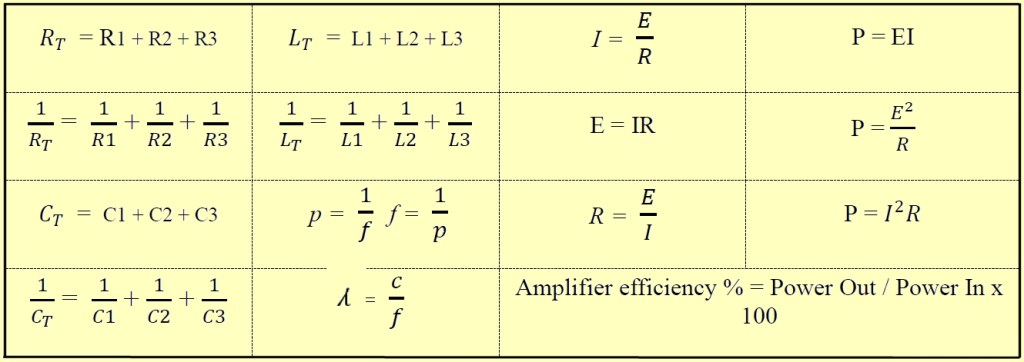
Note: The formulas in this table frequently use the symbol E to represent Voltage. E is an abbreviation of Electro Motive Force (EMF) Many educational documents use V for Voltage instead. For the purposes of this assessment, the symbol E and V are interchangeable.
7. The following symbols may be used in the examination:
 This Is Amateur Radio