
P22
Permissible Transmitter Output
Permissible Power Output
The Foundation Recognition Certificate restricts the transmitter output power to a maximum of 10 (ten) watts peak (Px). This should be measured either by the power output meter of the radio, or an external measuring device connected to the output of the radio. Note: You may also hear the power expressed as 10 watts PEP instead of Px. These terms mean the same thing.
Foundation operators are limited to 10 Watts Peak Envelope Power (PEP). It is important that you know how to measure your transmit power, and are also able to measure the VSWR.

If you find you are transmitting too much power, wind back the RF Power until your power meter’s readings do not exceed 10 Watts.
Testing Transmitters
When testing a transmitter, it is good practice and common courtesy to use a dummy load to prevent your test signals from being radiated and annoying or causing interference to other users on the bands.
A dummy load is a useful piece of test equipment that mimics an antenna, except that it dissipates the applied RF energy from a transmitter as heat, instead of radio waves. It’s usually a large 50 Ohm Carbon-film resistor that’s fixed into some kind of heat sink housing. Alternatively, a variety of smaller resistors in different series/parallel combinations that sum to 50 Ohms may be housed in a ventilated container.
Larger dummy loads are often immersed in oil, enabling them to dissipate higher power levels.
The Foundation Level Study Guide
All Blue Tiles form part of the syllabus for the Foundation Level Recognition Certificate (operator licence). A primary source of information for many of the blue tile topics can be found within the Foundation Level Study Guide. This is a free download available at:
https://vkradioamateurs.org/flsg/ This is a digital book and contains many links to other resources and explanatory videos.
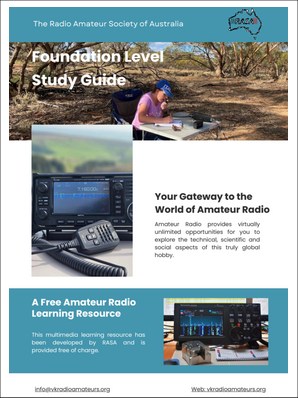
Information about Transmitter power can be found from Pages 12, 27, 64 & 65 in this book
ACMA Syllabus Extract
According to the ACMA Foundation Syllabus, the required knowledge on this topic is:
2.10 Permitted Power Output
Recall the maximum transmitter output power permitted under the Amateur Class Licence.
4.7 Transmitter Output Matching
Recall that the final power amplifier stage of a transmitter must be connected to a correctly matched transmission line and antenna to avoid possible damage to the transmitter and/or cause interference to other radiocommunications services
5.16 Testing Transmitters
Recall that when testing a transmitter, a non-radiating load (dummy load) is commonly used to prevent a signal from being radiated
 This Is Amateur Radio