
P229
Tracking Sources of Power Line Noise
Power line noise can be a major hindrance to Amateur Radio. It occurs whenever power line infrastructure near your home radiates electrical interference in the HF/VHF/UHF spectrum. It could originate from high voltage arcs between metal fittings or a buildup of dust on ceramic insulators. It can be difficult to find the precise origin of the noise because power lines can at as antennas that radiate the noise over several kilometres. As amateurs, we can’t take direct action on power line infrastructure but we can report it to power companies and try to persuade them to perform the repair for us. How well they respond to that request is going to depend on how the company is approached and the amount of advance information can be provided to them.
First, let’s become familiar with the sound signature of power line interference. This short You Tube clip is an actual recording of power line noise:
Frequency signature of power line noise
It is important to understand that when a power line noise is generated at a fitting on a power pole that the noise occurs over a wide range of frequencies. When trying to track the source, try to find the highest frequency that the noise can be heard, as the closer you get to the source, the higher this frequency reaches up the spectrum. At say 10 MHz it can be hard to identify the source within 500 metres, yet on UHF the same source can tracked to an individual pole.

The website https://qrm.guru/ is a knowledge base website dedicated to tracing and eliminating all sorts of interference sources and many of the tips here link to that site.

Tools for the Job
The best tool is a portable receiver of some kind able to tune in from 1 to 500 MHz with an AM receive mode. Some Amateur hand held transceivers can do this.
A basic stub antenna is enough to get started, but a small beam antenna or DF loop is very useful.
Here are links to videos on how to make a DF loop device and how to use one correctly. https://www.youtube.com/watch?v=Ivr9VbSgjUU
https://www.youtube.com/watch?v=7WHmUKh-3cc
An ultrasonic receiver is another great tool because it allows us to hear corona discharge sounds on power lines that are outside of human hearing. More about this strategy can be found on the tile dedicated to this topic.
https://thisisamateurradio.com/p230-tracking-interference-with-ultrasonics/

Thermal imaging tools have dropped in price. These can be useful to pinpoint hardware that is generating noise because there is usually a corresponding thermal signature at the source. This is even more evident in the mornings where heated surfaces provide greater contrast against the cool air.
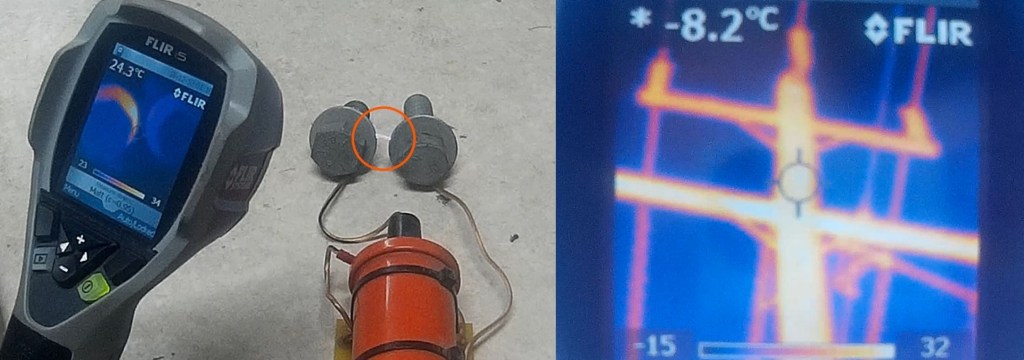
Portable spectrum Analysers have also dropped in price and these have the advantage of showing the full effect of the noise across the spectrum.

A case study into power line tracking
This clip recorded on a farm in NSW shows a VHF/UHF beam antenna being used to locat an interference on power poles.
Here are two excellent video clips by NG9D and W1MG on tracking a bad power pole using a handheld transceiver on other tools.
https://www.youtube.com/watch?v=kAKz8UMsAaQ
https://www.youtube.com/watch?v=aT-EFcZ7hbA
A map of Power Line Infrastructure
Several Eastern states of Australia have mapped their power lines and put them on a public website called Look Up And Live. This is an excellent tool as it formally identifies specific poles and tells us which company is responsible for every item.
https://byda.maps.arcgis.com/apps/webappviewer/index.html?id=8a8f088ca9774464884d6711b347fff8

If you can trace the origin of the noise to the nearest pole, then it is time to report the issue to the power company that manages that particular pole. Each pole has a unique reference number. Power companies do have points of contact for complaints, but be aware that some will attempt to fob you off to the ACMA, who in turn would send you back to the power company. Power companies do have an obligation to reduce or remove significant noise sources and this obligation can be reinforced by a state power ombudsman if necessary.
Is the noise confined to Amateur Radio?
An important recommendation is to see if the interference also wipes out AM/FM broadcast services. A complaint about interference to commercial services generally carries more weight than an Amateur Radio complaint on its own.
There are two articles on taking action and dealing with the regulator on the QRM Guru website:
 This Is Amateur Radio