P24
Qualification Levels Explained
Qualification levels
Amateur Radio operators hold an Amateur radio Class Licence, issued by the Australian Government Radio Regulator, the Australian Communications and Media Authority (ACMA).
The Amateur Radio License is divided into three different qualification levels. Advanced (A), Standard (S), Foundation (F). Each level has differences in the maximum permitted transmitter power and some variation in the bands and frequencies that may be accessed.

Maximum output power – Advanced Station
135.7-137.8 kHz – 1 watt effective radiated power
472-479 kHz – 5 watts effective radiated power
All other bands:
400 watts Peak Envelope Power (PEP – also known as Px) for the following modes:
(a) analogue television; or
(b) Single Side Band (SSB) suppressed carrier; or
(c) SSB reduced carrier.
For all other modes – maximum output power 120 watts mean power (also known as Py).
Maximum output power – Standard Station
Maximum output power 100 watts PEP for the following modes:
(a) SSB suppressed carrier; or
(b) SSB reduced carrier.
For all other modes – maximum output power 30 watts mean power.
Maximum output power – Foundation Station
Maximum output power 10 watts PEP for all modes.
Not all frequencies are exclusive to Amateurs
The Amateur Service operates on frequency bands set aside for their use, some of which are shared with other services on a non-interference basis. For the allocations we share with other users, we are referred to as Secondary Users. For the allocations dedicated to us, we are the Primary Users.
It is important to note that different countries and regions may have slightly different amateur radio band allocations and other restrictions. For example, in Europe the 2 metre band allocation is 144 to 146 MHz, but in Australia the band is a larger 144 to 148 MHz, with all the FM repeaters allocated within the upper 146 to 148 MHz section
The Foundation Level Study Guide
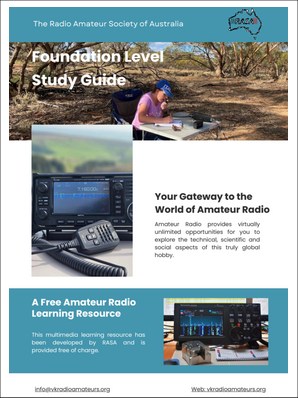
All Blue Tiles form part of the syllabus for the Foundation Level Recognition Certificate (operator licence). A primary source of information for many of the blue tile topics can be found within the Foundation Level Study Guide. This is a free download available at:
https://vkradioamateurs.org/flsg/ This is a digital book and contains many links to other resources and explanatory videos.
Details of the different qualification levels may be found on the ACMA website at:
https://www.acma.gov.au/qualifications-operate-amateur-radio
ACMA Syllabus Extract
According to the ACMA Foundation Syllabus, the required knowledge on this topic is:
1.1 Nature of Amateur Radio
Recall that amateur radio is intended to facilitate the hobby of radiocommunications
1.2 Types of Licenses (Qualification Levels)
Recall that amateur radio activities are authorised under the Amateur Class Licence and the Amateur LCD for beacon and repeater stations. Other forms of licences authorise different types of radiocommunications, such as citizens band (CB), land mobile, point-to-point links and broadcasting.
Recall that the amateur service operates on frequency bands allocated for amateur use. Recall that the amateur service shares some frequency bands with other services.
1.3 Allocation of Frequency Bands
Recall that services, such as broadcasting, aeronautical and maritime services, are allocated frequency bands appropriate to their purpose.
 This Is Amateur Radio