P25
Amateur Radio Regulations
Amateur Radio Regulations
Amateur Radio Regulations for a large part of the Foundation Qualification exam. It includes details such as license conditions, operating procedures, power levels, frequencies and more. The ACMA defines its regulations in a series of legal documents that are not easily understood, but the ACMA also has a reader-friendly version.
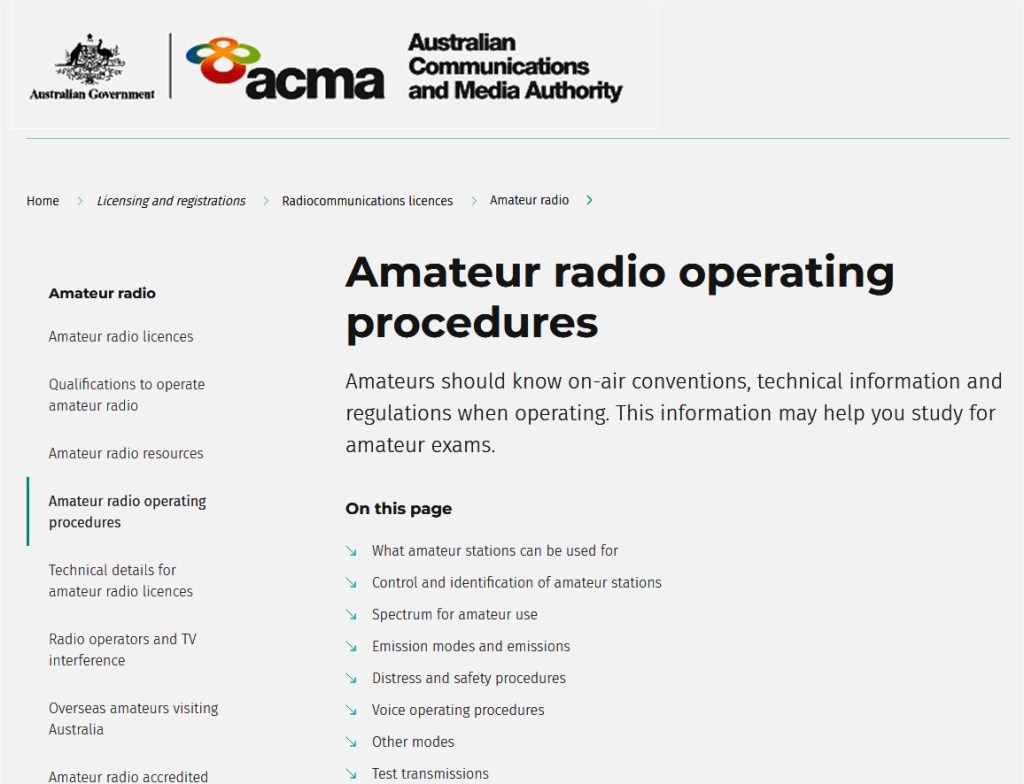
The Operating Procedures section may be viewed here:
https://www.acma.gov.au/amateur-radio-operating-procedures
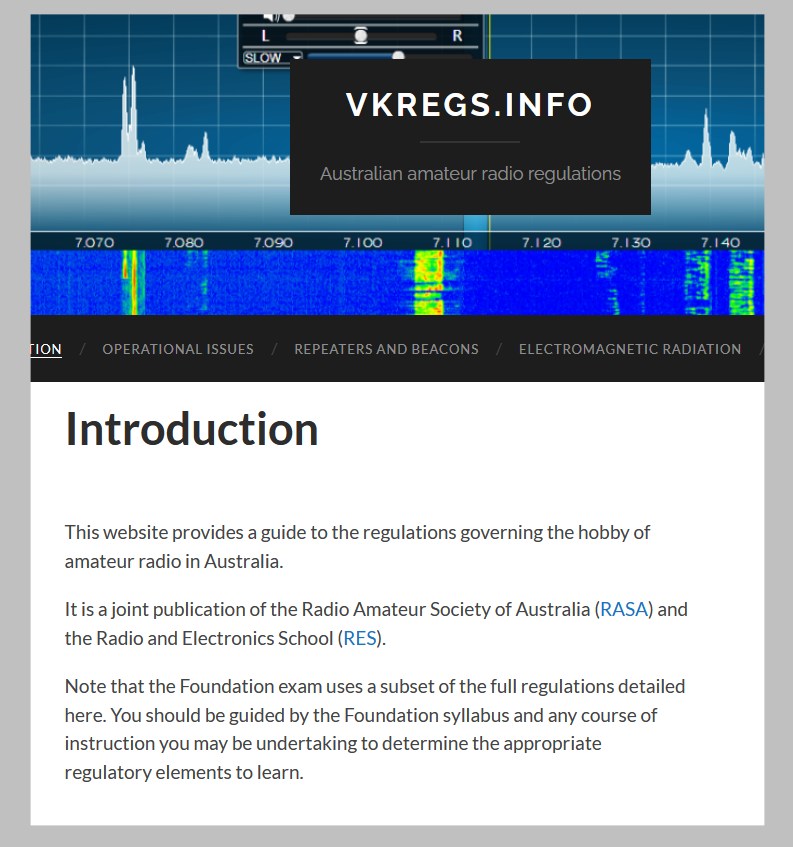
RASA has also produced a resource called VKREGS.INFO which brings together many of the regulations that define the use of Amateur Radio in Australia..
VKREGS.INFO may be found here:
A further summation of regulations relevant to Foundation Qualification levels can be found in the Foundation Level Study Guide (Below)
The Foundation Level Study Guide
All Blue Tiles form part of the syllabus for the Foundation Level Recognition Certificate (operator licence). A primary source of information for many of the blue tile topics can be found within the Foundation Level Study Guide. This is a free download available at:
https://vkradioamateurs.org/flsg/
This is a digital book and contains many links to other resources and explanatory videos.
Information about Regulations can be found from Pages 10 through to 13 and from pages 65 through to 69 in this book
ACMA Syllabus Extract
According to the ACMA Foundation Syllabus, the required knowledge on this topic is:
1.1 Nature of amateur radio
Recall that amateur radio is intended to facilitate the hobby of radiocommunications.
1.2 Types of licences
Recall that amateur radio activities are authorised under the Amateur Class Licence and the Amateur LCD for beacon and repeater stations. Other forms of licences authorise different types of radiocommunications, such as citizens band (CB), land mobile, point-to-point links and broadcasting.
Recall that the amateur service operates on frequency bands allocated for amateur use. Recall that the amateur service shares some frequency bands with other services.
1.3 Allocation of frequency bands
Recall that services, such as broadcasting, aeronautical and maritime services, are allocated frequency bands appropriate to their purpose.
2.1 Amateur conditions
Recall that operation of an amateur station is subject to conditions in the Radiocommunications Act 1992, the Amateur Class Licence and the Amateur LCD for beacon and repeater stations.
2.2 Purpose of the amateur service
Recall that the Amateur Class Licence primarily authorises the operation of an amateur station for self-training in radiocommunications, intercommunication between amateurs and technical investigations into radiocommunications.
2.3 Communications by amateur stations
Recall that, except in relation to a distress or emergency situation, or participating in emergency services operations or training exercises, the Amateur Class Licence only authorises amateur-to-amateur communications.
2.4 Third Party Operation
Recall that messages may be passed-on on behalf of third parties as long as they are not used for financial gain or reward.
2.5 Distress and urgency signals
Recall that distress communications are signalled by the use of ‘MAYDAY’ and that these communications have priority over all other communications.
Recall that anyone hearing a ‘MAYDAY’ communication is responsible for passing the information on to an appropriate authority.
Recall that some urgent situations not warranting the use of ‘MAYDAY’ are signalled by the use of ‘PAN-PAN’.
Recall that these communications should receive priority and should be reported to an appropriate authority.
2.6 Station identification
Recall that correct station identification is required at the beginning and end of a transmission and at least every 10 minutes during transmissions.
Recall that any transmission, even a test transmission, must contain station identification.
2.7 Amateur call signs
Identify from supplied reference material, the categories of call signs used in the Australian amateur service.
Recall all sign suffixes applicable to each licence category, prefixes and state designators
2.8 Encoded messages
Recall that the transmission of messages that are encoded to obscure their meaning is not permitted except for the purposes specified in the Amateur Class Licence
2.9 Authorised frequency bands and emissions
Recall the Amateur Class Licence authorises operation on certain frequency bands. Recall in which document the bands are specified.
2.10 Permitted power output
Recall the maximum transmitter output power permitted under the Amateur Class Licence.
2.11 Notification of change of contact details
Recall that an operator is no longer required notify the Australian Communications and Media Authority (ACMA) of any station address details.
2.12 Harmful interference
Recall that a person must not operate an amateur station if operation causes harmful interference to other licenced services.
2.13 Use of amateur stations
Recall that an amateur station cannot be used for financial gain.
2.14 Who may operate a Station
Recall that only people with suitable qualifications may operate a station
2.15 Use of a station by non-qualified persons
Recall that a person without amateur qualifications may communicate via an amateur station, provided the station is always under the full control of a qualified person.
2.16 The ACMA may obtain information or documents
Recall that the ACMA has the power to request information from an amateur, including evidence of their qualification.
2.17 Restriction of operation to avoid interference
Recall that the ACMA has the right to restrict the operation of an amateur station to avoid harmful interference
2.18 Use of the Amateur Class Licence and Amateur Class LCD
Identify the specific amateur conditions in the Amateur Class Licence/Amateur LCD for operating an amateur station on foundation frequencies.
2.19 Station security
Recall that an operable amateur station must not be accessible to unauthorised people.
7.12 Diplomacy and EMC
Recall that EMC problems have the potential for causing neighbourhood disputes. Understand the need for diplomacy, the sources of advice available and the role of the ACMA.
7.13 Harmful interference
Recall that a licensee must not operate an amateur station if its operation causes harmful interference to radiocommunication services.9.17 Safe Distances
 This Is Amateur Radio