
P27
Basic Units of Measure
Units of Measure
In all facets of science, mathematics and physics, we need accurate measurements for very large and very small values. Amateur Radio is no exception. Amateur Radio requires the measurement of voltage, frequency, length and many other parameters. Such quantities and values must be recorded with accuracy.
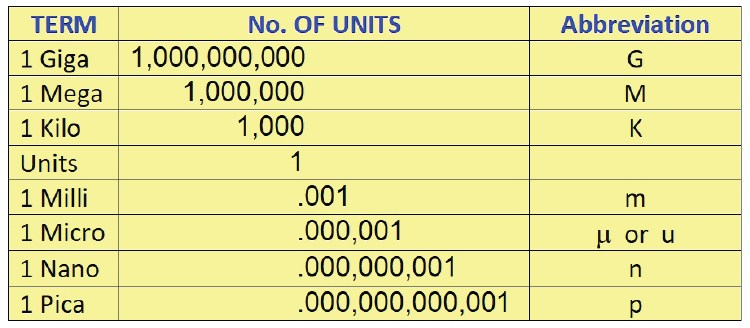
Many units and scales of measurement are in common use. For example, the metre is the metric unit of length, but it is routinely expressed in kilometres and millimetres for large and small scales. These two examples use the prefix ‘kilo’ to represent thousands of metres and ‘milli’ to represent thousandths of a metre. For Amateur Radio we need to be aware of a broader scale of units. The table below lists the most common units and scales in general use
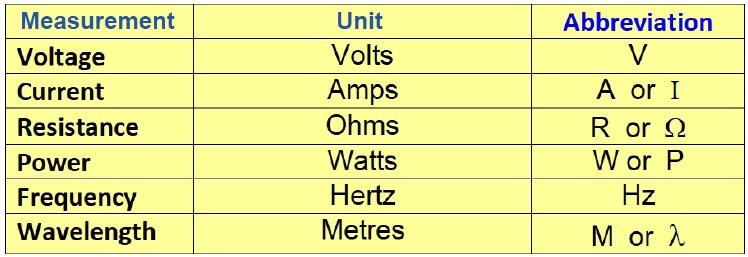
There are many parameters that can be measured, however for the Foundation Level, we only need to know the basic units of measurement. The table below presents the six most common units.
The Foundation Level Study Guide
All Blue Tiles form part of the syllabus for the Foundation Level Recognition Certificate (operator licence). A primary source of information for many of the blue tile topics can be found within the Foundation Level Study Guide. This is a free download available at:
https://vkradioamateurs.org/flsg/ This is a digital book and contains many links to other resources and explanatory videos.
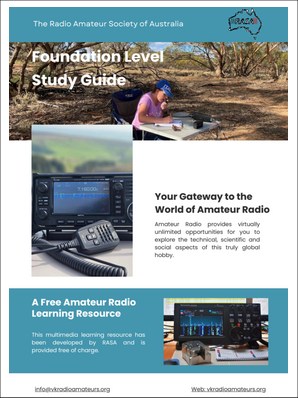
Information about Basic Units of Measure relevant to Foundation Level Qualifications can be found in this book from Chapter 3, Technical Basics
ACMA Syllabus Extract
According to the ACMA Foundation Syllabus, the required knowledge on this topic is:
3.1 Units of measurement, abbreviations and multiple/sub-multiple prefixes
Recall the units of, and abbreviations for voltage, current, resistance and power.
Recall the engineering prefixes milli, kilo and mega.
 This Is Amateur Radio