P29
Meaning of AM & FM Modulation
Adding Sound to Radio Frequencies
Both Audio (sound) and Radio are ‘waves’. They are voltages that alternate at different rates over time.
Audio waves may be a simple single waveform, such as a pure tone, or a complex blend of waveforms such as human speech. These waves have quite low frequencies as they travel through the air to our ears.
Radio waves are usually a simple single waveform, but they will be well above human hearing. When applied to an antenna, these waves will travel long distances. If they are only a single wave and nothing else they will contain no information other than being present or absent.
The act of attaching some form of information to a radio signal, means that the signal is now a carrier of information. The signal is then called a Carrier Wave.
The process of combining information to a Carrier Wave is called Modulation.
Carrier waves may be stopped and started, or ‘pulsed’ at deliberate intervals to convey information. The most basic form of this is Morse Code. Often Morse Code transmissions are called CW for Carrier Wave, or more accurately ICW for Interrupted Carrier Wave.
Sound can be combined with carrier waves using a few different techniques. The idea is that if sound, which can only travel through the air is used to vary a radio signal, then the radio signal can travel long distances. At the receiving end, the sound can be extracted from the radio carrier and converted back to something we can hear. This is called Demodulation.
Amplitude Modulation (AM)
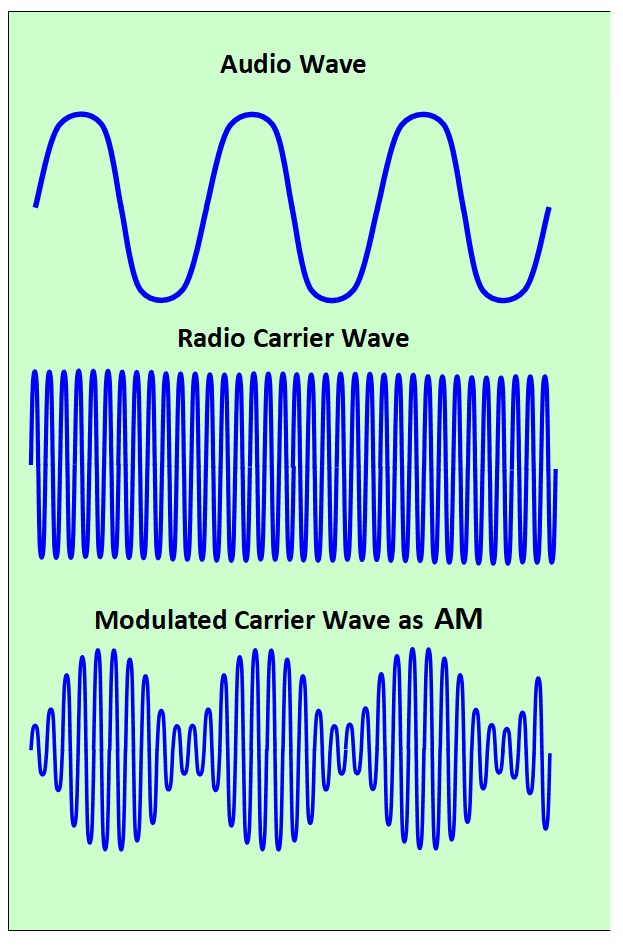
With this method, the carrier frequency is fixed and unchanging. When sound is merged with the carrier wave, the intensity, or ‘Amplitude’ of the radio wave will change as the applied audio waves change in intensity.
This effect of a basic sound wave changing carrier Amplitude may be seen in the image below.
It is important for Foundation candidates to be able to identify the pattern of modulation below as an AM radio signal.
Frequency Modulation (FM)
Another common and very effective method of combining sound with radio waves is to use Frequency Modulation.
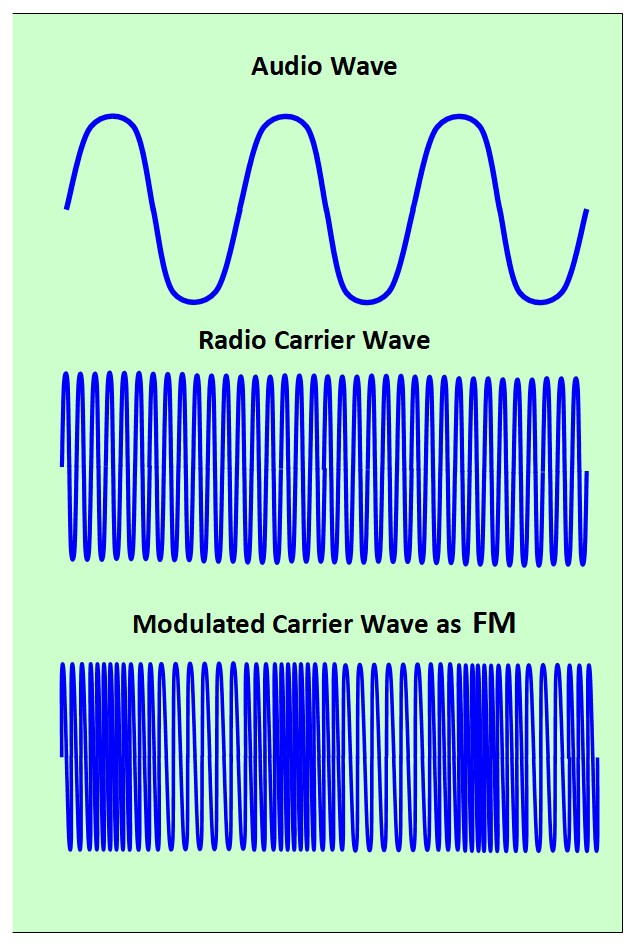
As may be seen in the image below, the height of the carrier wave remains constant, but the frequency of the carrier wave will drift up and down as the audio changes. This frequency shift effect is called Deviation.
The louder or more intense the audio wave, the greater the deviation in carrier frequency. If the audio frequency increases, the deviation will happen more often. If the audio frequency decreases in tone, the carrier deviation will occur more slowly.
The Foundation qualification requires candidates to be able to recognize a Frequency Modulated (FM) waveform as shown below.
ADVANTAGE OF FM over AM
AM is an effective method of modulating a radio signal. For more than a century AM radio stations have used this technique. There is a flaw. Atmospheric noise is also Amplitude based, so where reception is poor, the radio noise is added to the signal. At the receiving end signal and noise cannot be easily separated.
With FM transmissions, the sound information is affecting carrier frequency only. So if noise is added to the radio signal along the way, at the receive end, the noise can be trimmed off from the carrier and the carrier deviation is unchanged. The result is much better audio quality at the receive end.
The Foundation Level Study Guide
All Blue Tiles form part of the syllabus for the Foundation Level Recognition Certificate (operator licence). A primary source of information for many of the blue tile topics can be found within the Foundation Level Study Guide. This is a free download available at:
https://vkradioamateurs.org/flsg/ This is a digital book and contains many links to other resources and explanatory videos.
Basic Information about the modulation process relevant to Foundation Level Qualifications can be found in this book from Page 20, Technical Basics
ACMA Syllabus Extract
According to the ACMA Foundation Syllabus, the required knowledge on this topic is:
3.3 Audio and radio frequencies
Recall, using supplied reference material, the range of frequencies described as audio frequency (AF) and radio frequency (RF).
3.4 Meaning of AM and FM
Recall what is meant by the abbreviations AM and FM.
Recall how the radio frequency carrier is modified for AM and FM.
 This Is Amateur Radio