
P30
Lightning Protection Methods
Never use your station when there is an electrical storm nearby. Due to their height antennas can easily be hit by lightning. The use of lightning arrestors may reduce the risks and will discharge any high voltages induced by lightning nearby. Lightning arrestors will not provide protection from a direct strike. If you are using a tower ensure that it is adequately earthed as this will minimise damage.
Do not use headphones whenever there is electrical storm activity nearby.

The above image is of a lightning arrestor in the feedline to the antenna.
A good practice is to disconnect and earth antennas when not in use. Do not leave your feedline ‘floating’, as this may lead to a build-up in static electricity.

Station Earth – Besides the mains electrical earth, it is good practice to have a separate station earth. This is a separate ground connection and does not replace the electrical earth. A station earth or ground can consist of an electrical earth stake, driven 1 metre into the ground or as a series of wires or conductive mesh buried under the soil. Most equipment has an earth point and these are connected to the station earth. A station earth may also help with noise reduction and will improve the performance of some antennas (such as End Fed antennas) and may give better results with Antenna Tuning Units (ATUs).
The best place to read about this in some detail is within the Foundation Level Study Guide.
The Foundation Level Study Guide
All Blue Tiles form part of the syllabus for the Foundation Level Recognition Certificate (operator licence). A primary source of information for many of the blue tile topics can be found within the Foundation Level Study Guide. This is a free download available at:
https://vkradioamateurs.org/flsg/ This is a digital book and contains many links to other resources and explanatory videos.
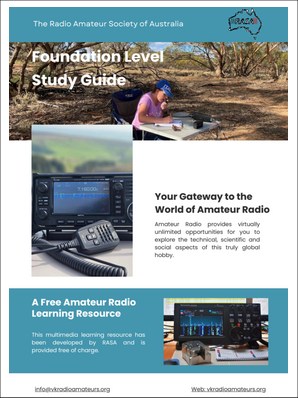
Information about Lightning Protection relevant to Foundation Level Qualifications can be found in this book from Chapter 9, ‘Safety’ from Page 78, 79
ACMA Syllabus Extract
According to the ACMA Foundation Syllabus, the required knowledge on this topic is:
7.1 RF Earthing
Recall that the function of the RF earth connection in an amateur station is to provide a path to ground to minimise RF currents entering the mains earth system and causing interference to other electronic equipment.
Identify, from supplied diagrams, the symbol representing an earth connection.
9.20 Lightning protection
Recall that it is good practice to install lightning protection on antennas, disconnect antennas from any radio equipment before a thunderstorm and never operate an amateur radio during a thunderstorm.
 This Is Amateur Radio