P34
Audio & Radio Frequencies
All frequencies are created by changes in the polarity of a voltage at different rates. If a voltage changes fifty times per second, then it matches the 50 Hertz (Hz) waveform we get out of our power outlets in Australia (60 Hz in the USA) .

When this frequency increases from around 300 Hz to 15,000 Hz (15 KHz) then we are looking at sound frequencies discernable by the human ear, which is generally referred to as the ‘Audio Spectrum’. When frequencies above this are correctly coupled to a length of wire or radio mast, they tend to radiate that energy for some distance at the speed of light. This is the lower end of the Radio Spectrum.
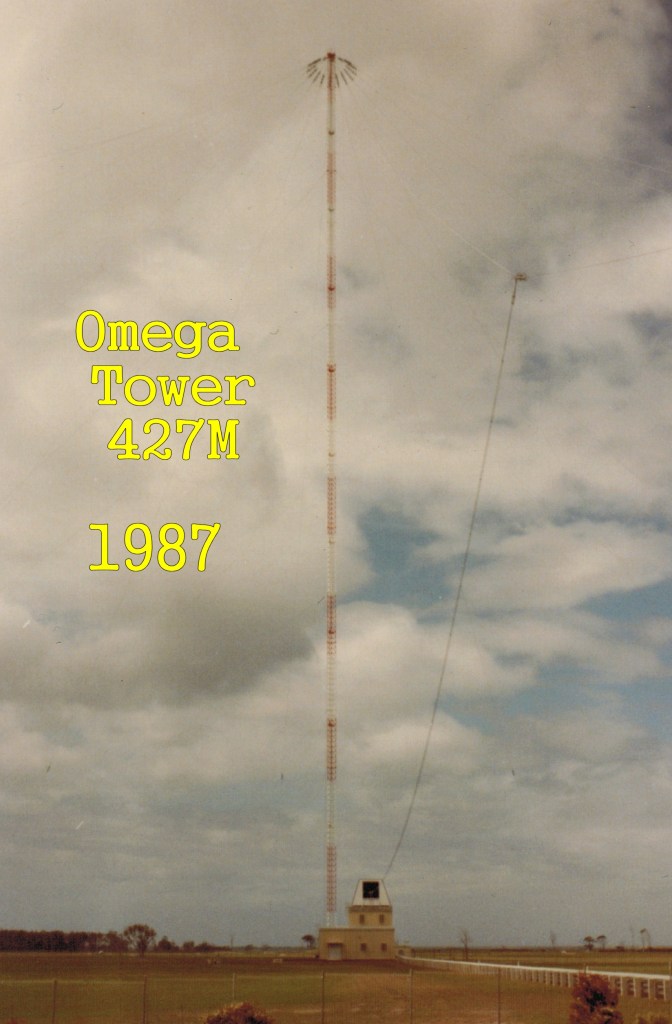
In the 1980’s a world wide network of transmitters radiated signals around 14-15 KHz for submarine navigation. One of the towers in this network was in Gippsland, Victoria.
Such low frequencies have very long wavelengths. This tower was 427 metres high.
The lowest frequency available to radio amateurs with an Advanced license is a small segment at 135.7 KHz, or 135,100 Hertz and our highest frequency allocation is around 250 GHz, or 250,000,000,000 Hertz. Amateurs have around 23 spectrum allocations between these two bands, although some of these are shared with other services.

The important aspect to recall here is that all radio frequencies allocated to Amateurs are simple Carrier Frequencies that contain no information, unless they are mixed with another signal.
For example the Australian AM radio broadcast band is between 531 KHz and 1629 KHz where all stations are spaced 9 KHz apart.
If we tune to a commercial AM station and nobody is speaking, or no music is playing we only hear a quiet ‘carrier’ which displaces the background static.
When this carrier frequency is mixed with an audio frequency in a process called Modulation, then we are able to extract the audio frequencies from the carrier at a distant end. This process is called Demodulation, where we can amplify the recovered audio sounds and play them through a loudspeaker.

Audio frequencies can be mixed with radio frequencies in several ways. The two most common methods are called Amplitude Modulation (AM) and Frequency Modulation (FM)
With AM signals, the audio sounds vary the height or ‘amplitude’ of the radio frequency, while with FM, the audio sounds can slightly shift the Frequency of the radio frequency.
AM/FM Confusion
Because commercial AM stations are between 531 and 1629 KHz and FM stations are between 88 and 108 MHz, many will believe that the modulation method is tied to a frequency range through nature. Technically it is possible to modulate 531 KHz as FM, or 88 MHZ as AM, but this is not done due to international conventions and the way the receivers are made and sold. Aircraft operate between 88 and 137 MHz using AM. While FM would provide greater clarity for aircraft, the logistics of changing every aircraft radio in service at the same time would be so difficult, it remains safer to continue with AM.
The Foundation Level Study Guide has a section on Audio vs Radio frequencies.
The Foundation Level Study Guide
All Blue Tiles form part of the syllabus for the Foundation Level Recognition Certificate (operator licence). A primary source of information for many of the blue tile topics can be found within the Foundation Level Study Guide. This is a free download available at:
https://vkradioamateurs.org/flsg/ This is a digital book and contains many links to other resources and explanatory videos.
Information on Audio & Radio frequencies can be found from Pages 24 & 25 in this book
ACMA Syllabus Extract
According to the ACMA Foundation Syllabus, the required knowledge on this topic is:
3.3 Audio & Radio Frequencies
Recall, using supplied reference material, the range of frequencies described as audio frequency (AF) and radio frequency (RF).
3.4 Meaning of AM and FM
Recall what is meant by the abbreviations AM and FM.
Recall how the radio frequency carrier is modified for AM and FM.
 This Is Amateur Radio