
P35
Ionosphere & Propagation Basics
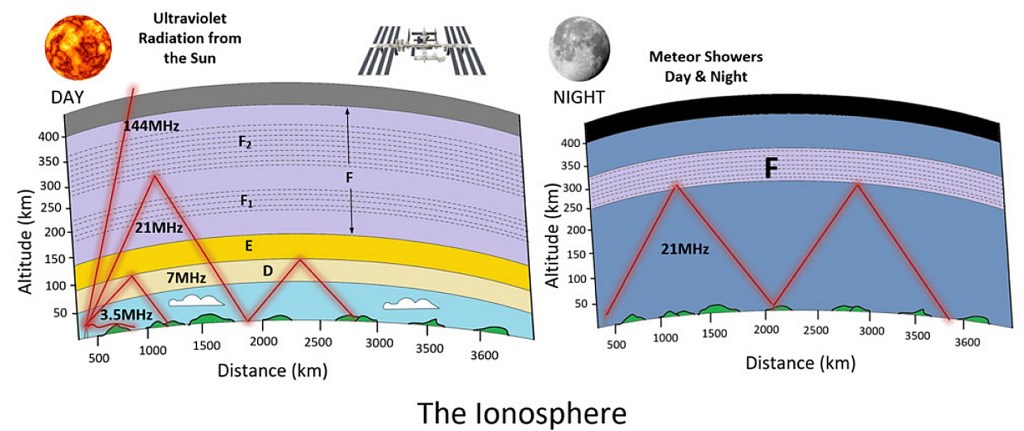
The Ionosphere and Propagation of Radio Waves
Radio propagation refers to the behaviour and characteristics of radio waves as they travel through the atmosphere or other media.
In free space, radio waves travel in a straight line, however, on earth they can be reflected, refracted, diffracted, or blocked. A good analogy is light, which generally travels in a straight line, but can be impacted by buildings, lights or clouds.
Radio wave propagation is affected by numerous factors, including: frequency, distance, atmospheric conditions, solar conditions, the terrain, obstacles they encounter, and the weather conditions in the area.
Overall, radio propagation is a complex phenomenon influenced by a variety of factors, and a fundamental understanding is important for designing and operating radio communication systems.
The Foundation Level Study Guide has an entire chapter dedicated to this topic.
The Foundation Level Study Guide
All Blue Tiles form part of the syllabus for the Foundation Level Recognition Certificate (operator licence). A primary source of information for many of the blue tile topics can be found within the Foundation Level Study Guide. This is a free download available at:
https://vkradioamateurs.org/flsg/ This is a digital book and contains many links to other resources and explanatory videos.
Information on Ionospheric Propagation can be found in Chapter 6 from Page 68.
ACMA Syllabus Extract
According to the ACMA Foundation Syllabus, the required knowledge on this topic is:
6.1 Propagation Basics
Recall that radio waves travel in straight lines, unless diffracted, reflected or refracted.
6.2 Effects of distance on Radio Waves
Recall that radio waves get weaker with distance as they propagate from the antenna.
6.3 Communication range
Recall that communication range at VHF/UHF is dependent on antenna height, a clear path, transmitter power and receiver sensitivity
6.4 Effects of Obstacles
Effect of obstacles and structures on VHF and UHF signals
6.5 Long distance communications on VHF and UHF
Recall that unusual atmospheric conditions may at times provide extended range.
6.6 The Ionosphere
Recall, using supplied reference material, that the ionosphere comprises layers of ionised gas at varying heights above ground.
6.7 Factors affecting HF propagation
Recall that ionospheric propagation is dependent on time of day, season, frequency and solar activity.
6.8 Ionospheric refraction
Recall that long-distance HF communication relies on propagation by ionospheric refraction
 This Is Amateur Radio