
P37
Calculating Volts, Amps, Ohms & Watts
The relationship between Voltage, Current & Resistance
The relationship between these three is known as Ohm’s Law. If any two values are known, then the third value can be calculated. Ohm’s Law can be transposed three ways to find a missing value

Calculating the amount of power in a DC circuit is an extension of Ohm’s Law:
- When a current of One Ampere exists through a resistance of One Ohm, the resistance dissipates One Watt of power.
(the resistance dissipates the power as heat into the air).
Power can be calculated if any two factors are known. For example, Voltage & Current, or Voltage & Resistance, or Current & Resistance.
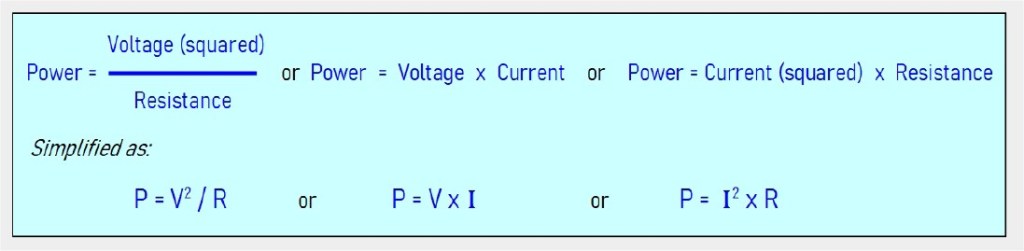
For example, a car headlamp of 25 Ohms is placed across the terminals of a 12V car battery and we wish to calculate the amount of power delivered to the lamp in Watts. We would use

.(12 x 12) / 25 = 5.76 Watts of Power
Calculating the power delivered by AC circuits is rather more complex since factors such as impedance and reactance must be taken into consideration.
The Foundation Level Study Guide has a section on Ohms Law and power calculations.
The Foundation Level Study Guide
All Blue Tiles form part of the syllabus for the Foundation Level Recognition Certificate (operator licence). A primary source of information for many of the blue tile topics can be found within the Foundation Level Study Guide. This is a free download available at:
https://vkradioamateurs.org/flsg/ This is a digital book and contains many links to other resources and explanatory videos.
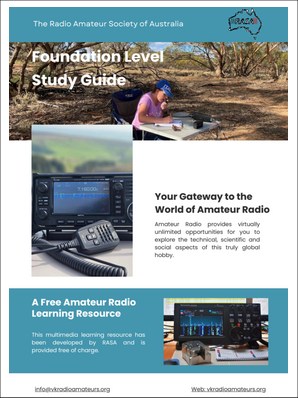
Information about Ohms Law & Power calculations relevant to Foundation Level Qualifications can be found in this book from Chapter 3, on Page 17
ACMA Syllabus Extract
According to the ACMA Foundation Syllabus, the required knowledge on this topic is:
3.5 Meaning of voltage, current, resistance and power
Recall the meaning of voltage, current, resistance and power.
Recall that electromagnetic radiation (EMR) can be dangerous and higher frequencies and power levels and proximity to the source increase the danger.
S3.6 Simple Calculations
Recall, using supplied reference material, the relationship between voltage, current, resistance and power.
Calculate an unknown value given the value of the remaining components.
 This Is Amateur Radio