
P39
Operating within Band Limits
There are 29 different sections of the radio spectrum allocated for Advanced Amateur Radio operation. Twelve of these are accessible by the Standard qualification holders and five for Foundation operators.
As a part of the examination process for the Foundation Recognition Certificate, it is not necessary to memorise each frequency verbatim, but rather be aware of where this information is and how to use it correctly.
Amateur Operators are limited to Amateur Bands
Operators should understand that other services such as Marine Radio and CB Radio have band allocations of their own. The Amateur qualification is only valid on Amateur bands and may not be used beyond our allocated frequencies. Similarly, operators of other services are not permitted to use primary Amateur band allocations.
Awareness of Secondary Service Operations
There are some allocations where Amateur Radio is regarded as a Secondary Service and Amateurs are permitted to use these frequencies on an non-interference basis to Primary users of that spectrum. For example, on the lower half of the Six Metre band, Amateur Radio is a Secondary Service.
Be Aware of your Bandwidth
Operators need to be aware that each transmission occupies a certain amount of bandwidth. For example, AM transmissions are 6 KHz wide, which means that it occupies spectrum space 3KHz above and 3KHz below the frequency selected on the VFO dial of a transceiver radio.
The Foundation allocation for the 80 Metre band is from 3.5 to 3.7MHz. If an operator was to select 3.501 MHz and commence an AM transmission, the edge of their 6 KHz transmission bandwidth would be 2 KHz below the bottom edge of the Amateur band. This would not be a legal transmission.
The table below Identifies the band edges of each allocation begin and end.

To explore the full technical detail of these band limits on the ACMA website visit:
https://www.legislation.gov.au/F2023L01648/asmade/text
(Scroll down some distance to Schedule A)
Band Usage within each Frequency Allocation
Within each band allocation, there are segments reserved for certain activities. These are not enforced, but by convention they have been established foster the co-existence of different transmission modes. For example, a conversation in progress between two stations on single sideband do not want to be disrupted by data packets being sent on the same frequency.
The Band Plan chart below describes these operating conventions in a handy form. It may also be downloaded from:
https://vkradioamateurs.org/its-my-frequency-and-ill-cry-if-i-want-to/

The Foundation Level Study Guide
All Blue Tiles form part of the syllabus for the Foundation Level Recognition Certificate (operator licence). A primary source of information for many of the blue tile topics can be found within the Foundation Level Study Guide. This is a free download available at:
https://vkradioamateurs.org/flsg/ This is a digital book and contains many links to other resources and explanatory videos.
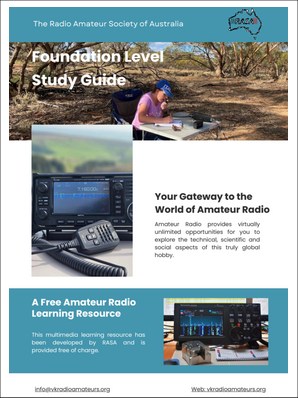
Information about Amateur frequencies and bands relevant to Foundation Level Qualifications can be found in this book from Chapter 1, on Pages 7 & 8
ACMA Syllabus Extract
According to the ACMA Foundation Syllabus, the required knowledge on this topic is:
1.2 Types of Licences
Recall that amateur radio activities are authorised under the Amateur Class Licence and the Amateur LCD for beacon and repeater stations.
Other forms of licences authorise different types of radiocommunications, such as citizens band (CB), land mobile, point-to-point links and broadcasting.
Recall that the amateur service operates on frequency bands allocated for amateur use.
Recall that the amateur service shares some frequency bands with other services.
1.3 Allocation of Frequency Bands
Recall that services, such as broadcasting, aeronautical and maritime services, are allocated frequency bands appropriate to their purpose
2.9 Authorised Frequency Bands & Emissions
Recall the Amateur Class Licence authorises operation on certain frequency bands. Recall in which document the bands are specified.
4.2 Emissions within Band Limits
Recall that all components of transmitter emissions must be contained within the radio frequency bands allocated to amateurs.
 This Is Amateur Radio