
P46
Fuses & Circuit Breakers
Fuses, Circuit Breakers & Protection methods
Fundamentally, fuses and circuit breakers perform the same function. They protect wiring. They will isolate any circuit or device that is drawing more current than is acceptable.
Each fuse or circuit breaker has a current rating and a response time. If the current flowing through the device is exceeded for longer than its response time, then the circuit beyond the device will be disconnected.
The primary difference between a Fuse and a Circuit Breaker is that a fuse is a single-use item. Once ‘blown’ it must be replaced, whereas a circuit breaker simply has to be reset to restore service.
Low voltage fuses
There are several different series of fuse style in use. Since the 1990’s blade fuses have become commonplace in automotive applications.
Glass encapsulated fuses are less common in automotive applications, but still used in 240VAC appliances.

One fundamental applies to all fuses. If a fuse is blown and needs to be replaced, it must be replaced with one of the same current rating.
- If the fuse is replaced with a lighter current version, then there is a high chance that the normal operation of equipment will blow the fuse again
- If the fuse is replaced with a higher current rated device, then there is a chance that the wiring it is supposed to protect may overheat and melt. Such an event would be a major fire hazard.
Basic Circuit Breakers versus RCD Breakers
Most homes will have some combination of resettable circuit breakers and the more advanced RCD breakers.
Basic circuit breakers have a current threshold only. In most Australian homes power outlets will have a 16 Amp breaker in line to protect the house wiring.

These are fast acting and will simply drop out when the current threshold is exceeded and are reset when the actuator is manually restored to the UP position.
The RCD breakers provide an additional layer of protection. RCD stands for Residual Current Device. In addition to automatically disconnecting power if excessive current is being consumed, RCD devices can also rapidly detect if a person is experiencing an electric shock. Such events will also act as a trigger for the automatic disconnection of power.

RCD devices work by measuring the outgoing current in the Active conductor and the return current in the Neutral conductor. Under normal conditions these two values should be identical. If the two values differ by as little as 20 milliamps, it concludes that something (or someone) is providing a leakage path to Earth that shouldn’t be there and forces an automatic disconnect of the supply.
RCD breakers always have a TEST button which deliberately creates a small earth fault. If the RCD is working correctly, the safety circuit will trip when the TEST button is pressed.
The AC Power Plug
Appliances that plug into Australian 230V mains power outlets have three pins labeled Active, Neutral and Earth. The Active and Neutral connections drive the load and the Earth connection is bonded to any exposed metal within an appliance. This improves safety for the operator of the appliance. All mains operated equipment with exposed metal surfaces should have an earth connection.
This diagram shows the standard connections of an Australian 3-pin plug.

It should be understood that any commercially manufactured appliance that connects to a 230VAC mains supply should have a label to show that the product is approved and meets Australian electrical safety requirements.
It should be noted that persons without appropriate electrical qualifications should not be working on mains wiring or carrying out tests on mains operated equipment.
The Foundation Level Study Guide
All Blue Tiles form part of the syllabus for the Foundation Level Recognition Certificate (operator licence). A primary source of information for many of the blue tile topics can be found within the Foundation Level Study Guide. This is a free download available at:
https://vkradioamateurs.org/flsg/ This is a digital book and contains many links to other resources and explanatory videos.
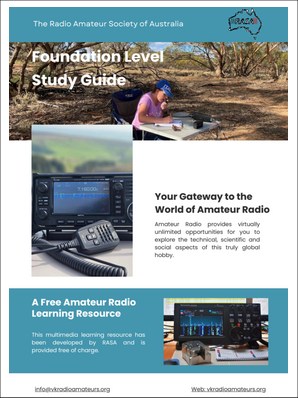
Information about fuses and circuit breakers can be found in this book from
Chapter 9, on Pages 72 & 73.
ACMA Syllabus Extract
According to the ACMA Foundation Syllabus, the required knowledge on this topic is:
9.1 Dangerous Voltages
Recall that high voltages and high currents are dangerous
9.2 Electrical safety – equipment to be approved
Recall that any mains-operated equipment sold, hired or supplied must be approved by an electricity authority or other relevant authority.
Recall that approved equipment will have an approval label.
9.3 Awareness of state electricity authority requirements
Recall that it is necessary to check relevant requirements regarding unqualified people wiring and testing mains-operated equipment. This includes leads, plugs and sockets connected to the household mains supply.
9.4 Electrical Earthing
Recall why most mains-operated equipment should have a safety earth connection.
9.5 Fuses
Recall that fuses prevent excessive currents that may cause heat damage or fires.
9.6 Correct fuse to be used
Recall that a correct fuse must be fitted to all electrical equipment.
9.7 Replacing Fuses
Recall the precautions to be taken when replacing faulty fuses including the selection of a fuse rated in accordance with an equipment manufacturer’s specifications or the requirements of an electricity supply authority
9.8 Station Layout for physical safety
Recall that the layout of an amateur station should take account of physical safety issues.
Recall that trailing cables are trip hazards and dangerous.
9.9 Power Lead Safety
Recall that frayed or damaged power leads are dangerous and should be replaced or repaired by an authorised person9:16 Radio waves can be dangerous
 This Is Amateur Radio