P47
AM & Sideband Modulation
A General Description
A somewhat confusing aspect of Amateur Radio transmission is the difference between transmitting AM (Amplitude Modulation) or SSB (Single Sideband)
AM is the original voice transmission method and is still sometimes still used today. It has some limitations. One is that it uses up to 6 KHz of bandwidth and this limits the number of station that can operate on a band at the same time. It also has power efficiency problems, as the transmitter is fully active, consuming spectrum space, even if the person with the microphone is not actively speaking.
SSB is a variation on AM, which consumes less power from the transmitter and uses less bandwidth, around 3KHz. It also performs better than the original AM under noisy conditions. SSB has become the de-facto standard for voice communications over long distances. Before we can understand the differences from AM we first have to visit what is happening in an AM transmission.
How AM transmissions work
It is called Amplitude Modulation because we produce a plain radio wave frequency, called a ‘carrier’, then we take a varying-voltage voice frequency, amplified from a microphone and use it to vary the intensity or ‘amplitude’ of the carrier radio wave. The act of mixing these two frequencies is called Modulation, because we use the Sound to Modulate the Carrier.
(Note there is another technique for modulating a carrier by shifting a carrier with a voice signal, rather than varying its height. This is called Frequency Modulation (FM) and it is the subject of different page. )
This image shows the two source signals and the combined AM signal in green.

Another way of looking at this process is to view the impact of AM on the radio spectrum.
This image shows the effect of a single carrier frequency on the radio spectrum. It is just a radio wave. Nobody is talking. It occupies very little space.

When we modulate this carrier frequency with sound, we add extra energy to the signal and we increase the amount of spectrum space used. In this instance we occupy 3 KHz above the carrier frequency and 3 KHz below it. 6 KHz in total. These extra spaces used are called ‘Sidebands’

Note that the speech information applied has produced both an Upper and Lower Sideband, even though one is effectively a mirror image of the other, carrying the same information.
This is where the SSB trick comes in. The transmitter uses a filter process to ‘suppress the carrier’ which means that when nobody is talking there is no carrier and nothing is being transmitted.
Then we use more filtering to block out one of the sidebands, as both have the same sound information superimposed. If we block out the Upper Sideband and the carrier, then only the Lower Sideband is transmitted, or LSB. This signal is only transmitted as long as we are talking. Between words, no power is being transmitted.
To transmit Upper Sideband or USB, we must switch the filter to block out the Lower Sideband.

One of the unusual international conventions in Amateur Radio is that the 40 and 80 metre Amateur bands both utilise Lower Sideband (LSB) while almost all other voice transmissions on the rest of the bands use Upper Sideband USB transmitter mode.
Good and Bad points about SSB
The best part about Sideband transmission is that it only uses 3 KHz of space on the air, so more stations can use a band allocation than AM. The worst part about SSB is that at the receive end, there are extra steps and stages to extract the sound properly from the transmitted signal, or it will sound quite garbled. That is the topic of a different page.
Further Studies
Here is a brief YouTube clip which helps to explain the differences between AM and SSB with some animations:
The Foundation Level Study Guide
All Blue Tiles form part of the syllabus for the Foundation Level Recognition Certificate (operator licence). A primary source of information for many of the blue tile topics can be found within the Foundation Level Study Guide. This is a free download available at:
https://vkradioamateurs.org/flsg/ This is a digital book and contains many links to other resources and explanatory videos.
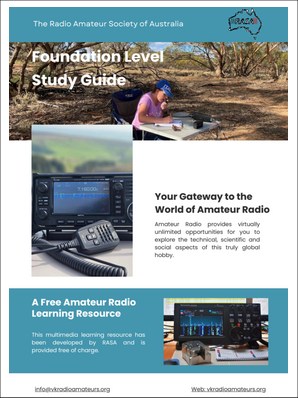
Information about SSB relevant to Foundation Level Qualifications can be found in this book from Chapter 4, on Pages 23 to 27.
ACMA Syllabus Extract
According to the ACMA Foundation Syllabus, the required knowledge on this topic is:
2.10 Permitted power output
Recall the maximum transmitter output power permitted under the Amateur Class Licence.
3.4 Meaning of AM and FM
Recall what is meant by the abbreviations AM and FM.
Recall how the radio frequency carrier is modified for AM and FM.
4.1 Block or Concept diagrams of simple Transmitters and Receivers
Identify, using supplied block diagrams, the names of the stages in a simple transmitter and receiver.
4.4 Identification of Waveforms
Identify, with the aid of supplied diagrams, a radio frequency carrier waveform, an audio frequency waveform and a modulated waveform
4.5 Waveform Generation
Identify, using supplied block diagrams, where the carrier, audio and modulated waveforms occur in a simple transmitter.
4.6 Types of Amplitude Modulation
Recall that single sideband (SSB) is a form of amplitude modulation (AM).
 This Is Amateur Radio