P48
Repeaters & how they work
What Repeaters do
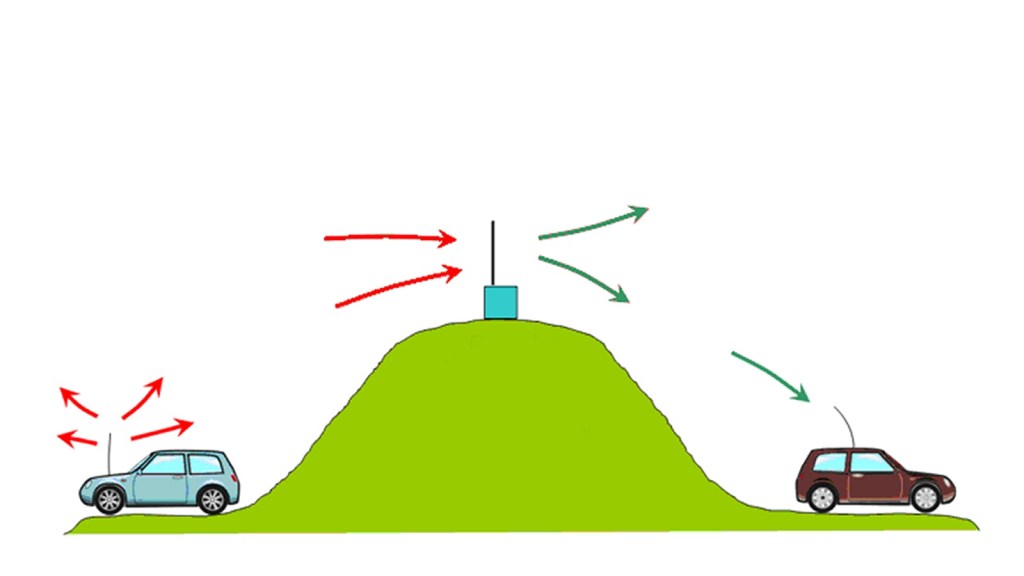
Most FM/digital voice operation uses repeaters. Repeaters are designed to receive signals and rebroadcast them, thereby allowing stations who might normally be out of range to communicate. The higher the repeater is above the surrounding area, the greater the range.
There are dozens of 2m and 70cm repeaters across Australia, often located on mountain tops. Some repeaters provide coverage over hundreds of square km.
Repeater Use
Foundation Licence candidates are required to demonstrate the correct use of voice repeaters.
You don’t normally call CQ on repeaters, rather simply announce that you are listening – i.e.
VK2FXYZ listening Repeaters are a shared resource – once you have established contact with another station, always leave pauses between overs to allow other stations to break in. If you can hear the other station directly, you should QSY (change frequency) to a simplex (direct) channel if possible.
Leave a break for other operators
As with any frequency, always listen first to ensure the repeater is not already in use. When operating through a repeater leave adequate breaks between transmissions.
This will allow other users to access the repeater if required.
If you are likely to have an extended contact and the other station is within range, you should move to a simplex frequency and leave the repeater available for other users.
You normally do not call CQ on a repeater – just announce that you are listening –
i.e. “VK2ABC listening”
Maps of Australian repeater locations may be found at:
https://www.onlinerepeatermap.com/
This video clip describes some of the fundamentals of repeater operation.
CTCSS & DTMF Tones
Foundation Licence candidates are also required to have a basic awareness of audio tones that are used to access and control. This includes the use of Continuous Tone Coded Squelch System (CTCSS) and Dual Tone Multiple Frequency (DTMF) access control systems.
Click on this link CTCSS and DTMF or file the tile of the same title to learn more about how these tone systems are used for Amateur Radio.
The Foundation Level Study Guide
All Blue Tiles form part of the syllabus for the Foundation Level Recognition Certificate (operator licence). A primary source of information for many of the blue tile topics can be found within the Foundation Level Study Guide. This is a free download available at:
https://vkradioamateurs.org/flsg/ This is a digital book and contains many links to other resources and explanatory videos.
Information about using repeaters can be found in this book from Chapter 3, on Page 67.
ACMA Syllabus Extract
According to the ACMA Foundation Syllabus, the required knowledge on this topic is:
8.4 Operating Practises
Demonstrate, by making on-air contacts using appropriate calling procedures, the correct operation of HF and VHF/UHF transmitter/receivers.
Demonstrate the use of a signal strength meter to make meaningful signal reports.
8.5 Operating through a Repeater
Recall and demonstrate, using supplied reference material, the correct use of voice repeaters, including the use of continuous tone-coded squelch system (CTCSS) and dual tone multiple frequency (DTMF) access control systems.
8.6 Leaving Breaks when using a Repeater
Recall and demonstrate the need to leave adequate breaks between transmissions when using voice repeaters.
 This Is Amateur Radio