P50
CPR Resuscitation Techniques
What is CPR?
CPR (short for cardiopulmonary resuscitation) is a first aid technique you can use on someone if they are not breathing or if their heart has stopped.
CPR is a skill that everyone can learn — you don’t need to be a health professional to do it.
- Try to stay calm if you need to do CPR.
- Performing CPR may save a person’s life.
- If you know CPR, you might save the life of a family member or friend.
CPR involves chest compressions and mouth-to-mouth (rescue breaths). The aim is to circulate blood and oxygen in the body to keep the brain and vital organs alive until specialised treatment is available.
When should I start CPR?
Start CPR as soon as possible if a person is:
- unconscious (not responding to you)
- not breathing
- breathing abnormally (for example, gasping for air or grunting)
The best way to learn this skill is with direct training.
Quality advice is available on the Australian Government site Health Direct, which you can reach via this link:
https://www.healthdirect.gov.au/how-to-perform-cpr
St Johns Ambulance have an excellent short video. (Below)
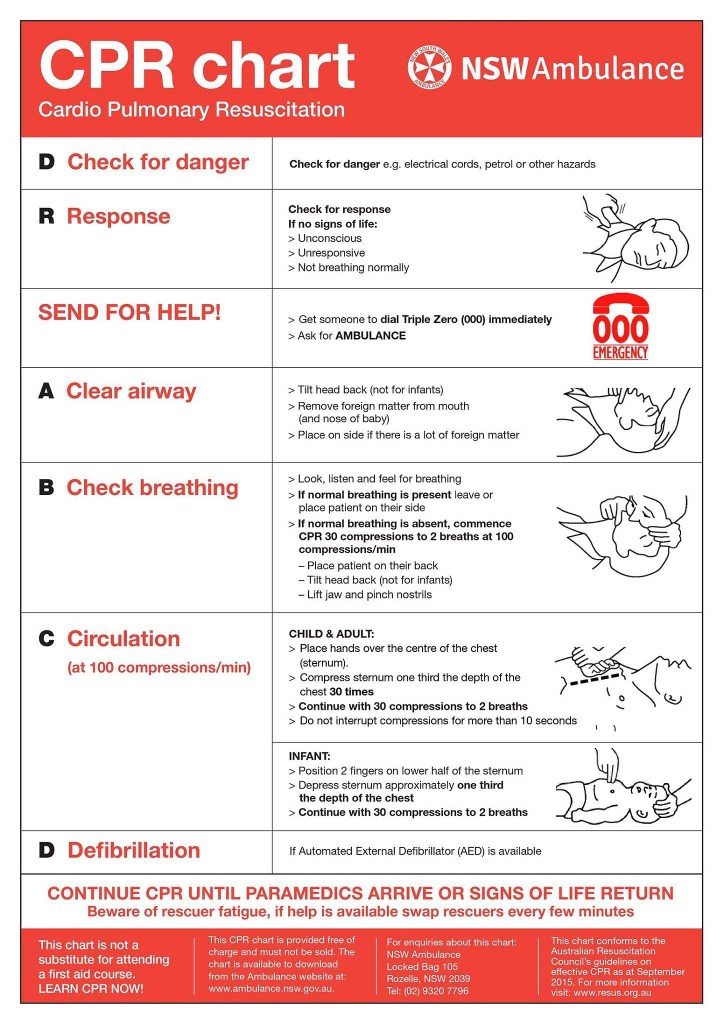
This wall chart is a brief summary of the CPR process,
The Foundation Level Study Guide
All Blue Tiles form part of the syllabus for the Foundation Level Recognition Certificate (operator licence). A primary source of information for many of the blue tile topics can be found within the Foundation Level Study Guide. This is a free download available at:
https://vkradioamateurs.org/flsg/ This is a digital book and contains many links to other resources and explanatory videos.
Information about physical safety and CPR can be found in Chapter 9 from Page 71 in this book.
ACMA Syllabus Extract
According to the ACMA Foundation Syllabus, the required knowledge on this topic is:
9.8 Station Layout for physical safety
Recall that the layout of an amateur station should take account of physical safety issues.
Recall that trailing cables are trip hazards and dangerous.
9.9 Power Lead Safety
Recall that frayed or damaged power leads are dangerous and should be replaced or repaired by an authorised person.
9.10 Know location and desirability of a Mains OFF switch
Recall the desirability for a clearly marked switch to turn off all station equipment in an emergency.
9.11 Actions to be taken in the event of an accident involving electricity
Recall that, in the event of an accident involving electricity, the first action is to safely switch off the power.
9.12 Electric Shocks
Recall that a casualty of electric shock must not be touched unless the power has been switched off.
9.17 Safe Distances
Recall that a safe distance from an antenna depends on the ERP, operating frequency, antenna type and orientation.
 This Is Amateur Radio