
P52
The Differences between Analog & Digital
What is Analog and what is Digital?
On the face of it, this is a simple question, but the answer is complex. It comes down to the context in which it was asked. A simple comparison would be a digital clock versus an analog clock. One has moving hands on a dial and the other has digits that tell the time as changing numbers. In this clock example the distinction is clear, but in other situations, the differences are less obvious.
In its basic form Digital means that a medium can assume one of two states. On or Off. High or low. Voltage, no-voltage. Analog refers to a state that can be anywhere between two levels or conditions. In more advanced forms Digital may still only consist of two states, but it can mimic analog signals of such high resolution, that the user can no longer pick the difference.
Analog vs Digital in Early Communications
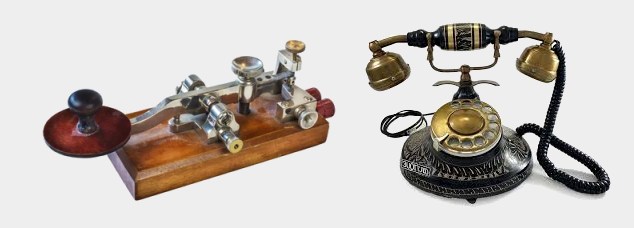
The first real comparison between Digital and Analog came with early wire transmission methods. The term Telegraphy was applied to Morse code transmission being sent over wires. The word Telephony was the act of sending a spoken voice over wires. At the time, this was the only definition that mattered
Telegraphy was expanded to include more mechanized data transmission in the form of the teleprinter. Dots and Dashes gave way to a serial data transmission as a five bit code called Baudot. Arguably this is the beginning of the digital revolution.
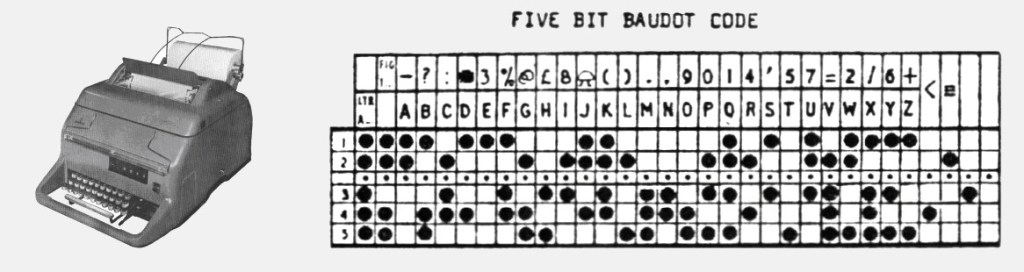
The teleprinter could be connected to a radio where the two data states were represented by alternating audio tones. This became Radioteletype or RTTY. The you tube video below shows an early Siemens mechanical teletype machine in action.
To see the full Radioteletype article visit: https://www.qtcmag.com/books/elbd/#p=23
Analog vs Digital in Measurement
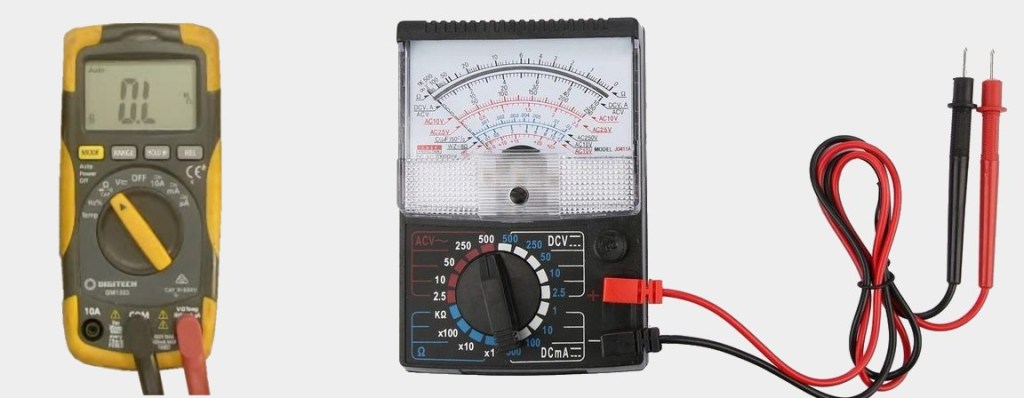
This is a different context, but the words are in common use. Analog and Digital meters have been developed to measure almost everything. The test equipment measures the same signals but how it presents the result may be Analog in the form of a moving needle or gauge, or Digital represented by numbers expressed as digits on a screen or LED display
A good example is the Analog and Digital multimeter. Both can measure analog voltages and currents, but the operator reads either a numeric display or a moving needle.
Analog vs Digital Radios
Yet another context of Analog vs Digital. With both Analog and Digital radio operators can talk into a microphone and their voice will come out of a speaker at a distant location. The end result is similar, but how this outcome is achieved is very different.
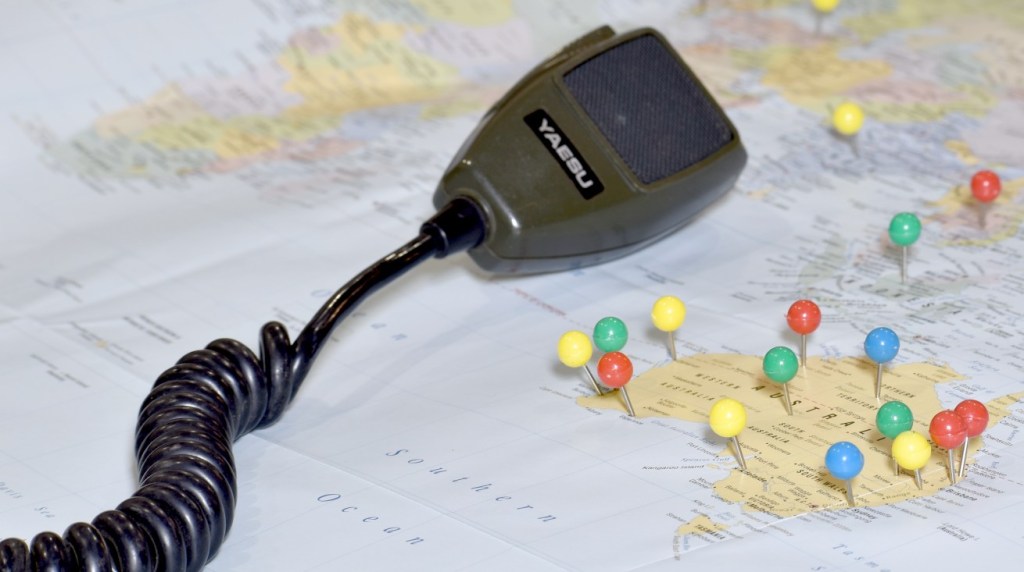
Analog radios use the voice to directly modulate a radio carrier wave in AM or FM or Single Sideband (SSB). At the receive end another stage called a Demodulator extracts the sounds from the radio signal and delivers it to a speaker.
Digital radios breaks the voice audio down into high density data packets then sends these packets at high speed into a digital network which may or may not include the internet. Information density is higher then normal speech so more than one conversation at a time can take place over the same transmitted bandwidth as an analog transmission. These techniques are used with different protocols by different companies. The radio manufacturer Yaesu have developed a digital service called Fusion. Other manufacturers usd DMR (Digital Mobile Radio). Special repeaters have been established in many cities to support this technology.
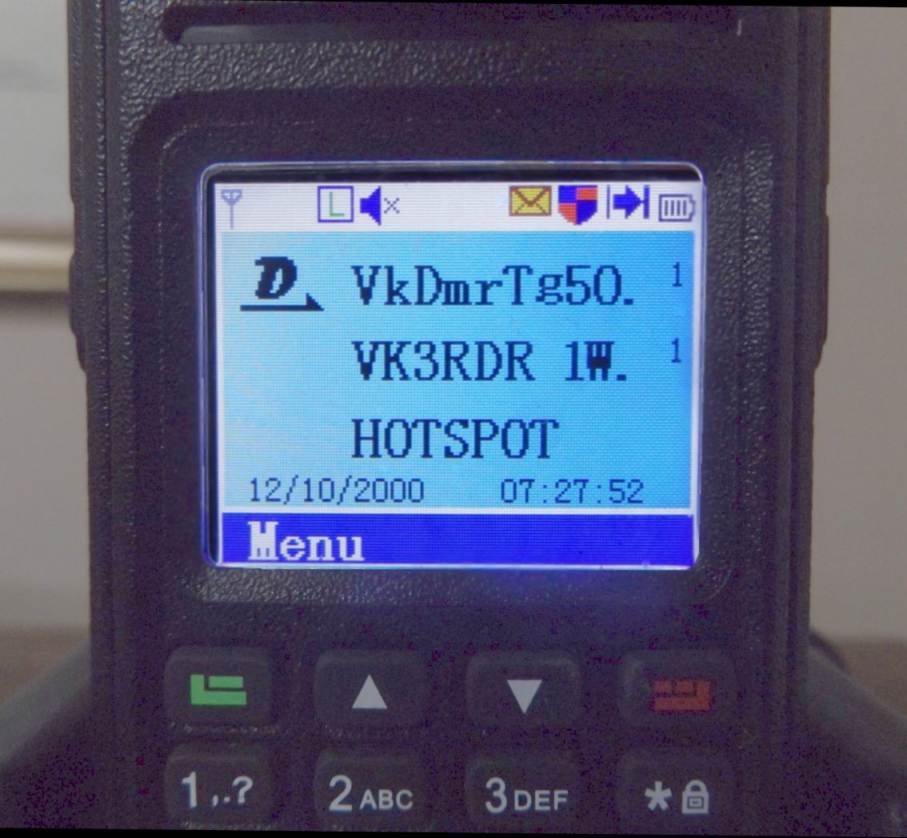
Transmitted Analog signals are incompatible with Digital receivers and vice-versa. Each cannot decode the other. On the Amateur bands space has been put aside for both Analog transmissions (AM/FM/SSB) and Digital transmissions (Morse, RTTY, Packet radio, DMR, FT8 etc.) This isolation helps to prevent one type of transmission from interfering with the other.
Analog vs Digital in Electronics
At the circuit board and experimenter level Analog versus Digital is regarded as a method for a microprocessor or similar electronic circuit to measure the outside world. A microprocessor can use one pin to measure the state of a switch to see if it is ON (zero volts) or OFF (5V). This is a Digital Input.
Microprocessors often need to read an analog sensor for measurements like temperature or light level. It uses a special stage called an A to D Converter, or ADC. This will convert a level to a number that will represent a voltage somewhere betweem zero and 5 volts. The quality or coarseness of the reading will depend upon how many bits of data are used to receive the conversion. 8 bits of data can express a voltage in a range from 0 to 255. If 10 bits of data are decoded, the resolution doubles twice to 1024 values for the same 0 to 5V range. This gives the reading a staircase effect.
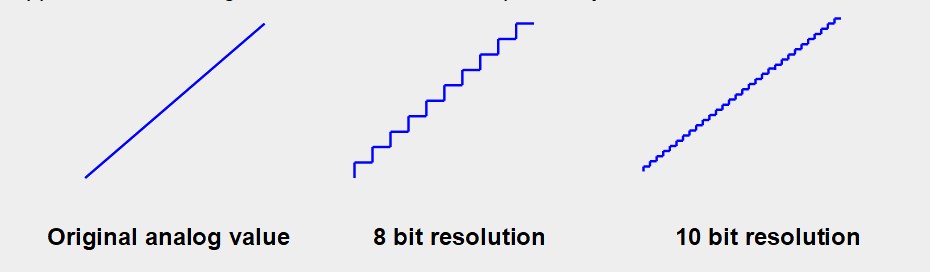
In this way any Analog value may be expressed as a digital number, but the resolution must be fit for the purpose. 8 bit resolution may be sufficient to record a temperature reading to the nearest full degree Cº but can’t report shifts in 0.1º steps. To achieve that the microprocessor must deploy higher resolution sampling such as 12 bit (4096 divisions between 0 and 5V)
This topic is a large one, beyond the scope of this site, but we have broadly explored some of the meanings between the two expressions of Analog and Digital.
ACMA Syllabus Extract
According to the ACMA Foundation Syllabus, there is no directly examinable content of Analog versus Digital technology, however, references are made to both Analog and Digital transmission modes with respect to band planning, non-interference between modes and operator awareness of possible overheating of prolonged digital transmissions because of their high duty cycles.
 This Is Amateur Radio