
P59
Constructing an RF Filter Choke
There will be many situations where we want to absorb unwanted radio frequencies from travelling along a conductor. An appliance may be radiating interference through its speaker cable, power cable, HDMI video or internet connection.
The best way to resolve this is to pass the cable through a ferrite clamp or sleeve, or wrap the cable around a ferrite ring or rod.
Ferrites absorb radio frequencies. They are manufactured from blends of iron powders and other metal oxides. The exact composition determines the frequency range of absorption. Type 43 is the most common material in use.
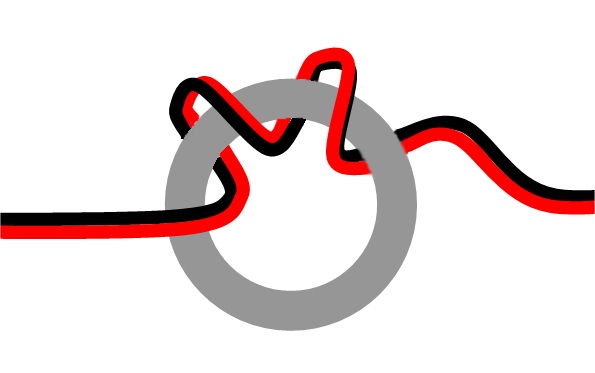
There is a direct relationship between the number of turns around a ferrite core versus the degree of Radio Frequency absorption. Every time you double the number of turns around a ferrite, its effectiveness is multiplied by four.
For example a wire running through a ferrite clamp once will have some filtering effect, but if an extra turn can be placed around that clamp, its effectiveness is similar to passing one wire through four clamps.
The video clip below shows how to construct a filter made from cable and ferrite materials.
Visit QRM Guru
The topic of interference filtering and mitigation is a large one. In 2018 a website was established specifically aimed at resolving interference problems for Amateur stations. It is a knowledge based site, meaning that key words and clues may be entered to bring up data, case studies and video clips relevant to the search topic.
Click on the graphic below to open the QRM.guru site.

The Foundation Level Study Guide
All Blue Tiles form part of the syllabus for the Foundation Level Recognition Certificate (operator licence). A primary source of information for many of the blue tile topics can be found within the Foundation Level Study Guide. This is a free download available at:
https://vkradioamateurs.org/flsg/ This is a digital book and contains many links to other resources and explanatory videos.
Information on RF Filters can be found from Page 58 in this book
ACMA Syllabus Extract
According to the ACMA Foundation Syllabus, the required knowledge on this topic is:
7.9 Filters
Recall that the immunity of most types of equipment can be increased by fitting suitable filters in external cabling, such as antenna, power supply or interconnections between equipment.
Recall that the filters should be fitted as close to the affected devices as possible.
7.10 Simple Choke Filter
Recall how to construct a simple RF ‘choke’ filter using a ferrite rod or toroid.
 This Is Amateur Radio