P64
Transmitter Adjustment Importance
A part of obtaining an Amateur license is the awareness of the impact a transmitter can have on people near the equipment and the community near the station.
Transmitter equipment comes in many types and sizes, so some generalization is required when describing the importance of transmitter tuning.
A transmitter generates Radio Frequency (RF) energy that is intended to be directed to an antenna. When this is done correctly, there is very little negative impact upon surroundings.
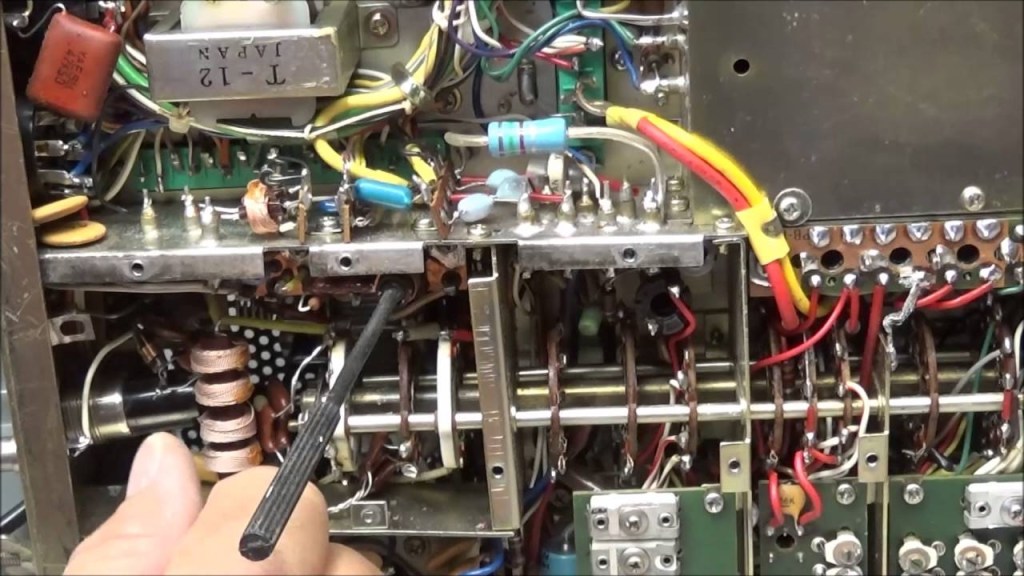
Inside the radio
Within the interior of a radio there are many tuned circuits that have been delicately optimised by the manufacturer for maximum power transfer and a minimum of losses. If a key component fails or, an incorrect adjustment is made there can be consequences. Circuits may no longer be resonant and heat can be dissipated in parts that can be permanently damaged. A poorly tuned transmitter on say 3.6 MHz could cause harmonic interference to services on 7.2 or 10.8 MHz. Self-oscillations can occur at frequencies at odd, seemingly unrelated parts of the spectrum affecting other receivers into VHF and UHF. Internal shielding components within a transmitter should never be removed while transmissions are in progress.
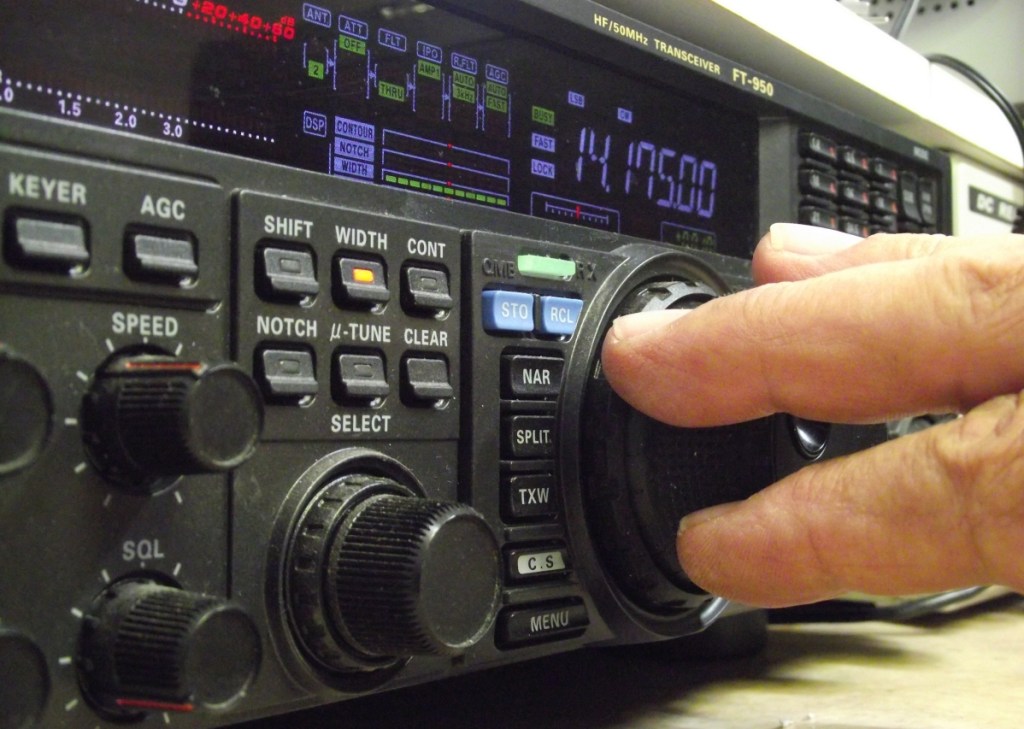
Poorly tuned controls.
Even with a radio in a safe, sealed state, many radios have operator controls that can cause problems if used incorrectly. When making antenna checks and adjustments it is advisable to set the transmitter output to a low power setting of just a few watts until correct alignments and checks are confirmed to be satisfactory. Then it is fine to gradually increase power to operational levels.
If microphone gain controls are turned too high, voice peaks can become clipped and distorted and generate local interference. If reports from other stations advise of poor quality audio, operators should reduce drive levels and try again
Frequency Adjustments
One of the responsibilities of an operator is to ensure that the radio remains within the allocated frequency range of each band. This includes an awareness of transmission bandwidth. For example a Morse Code transmission of pulsed carrier just 2 KHz away from the edge of a band may be fine, but a voice transmission on the same frequency, which has greater bandwidth (3KHz for SSB and 6 KHz for AM) could be causing some emissions outside of the allocated space.
From the Radio to the antenna
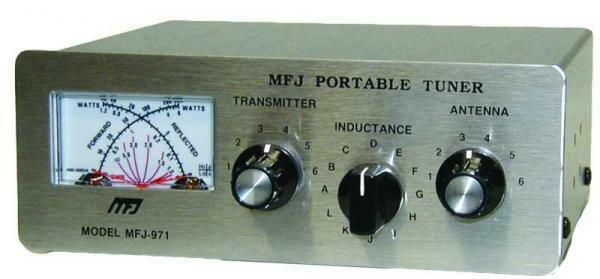
Other sections describe the importance of grounding and low SWR on antenna matching. This includes the use of Antenna Tuning Units. A series of adjustments are required on tuner units to ensure clean transmission of power to the antenna. If the operator changes bands on their radio, then the band selection on the antenna tuner also needs to be changed and the match re-adjusted. Even moving between frequencies within a band, such as on 80 Metres, antenna tuners usually need some adjustment.
Failure to correctly tune an ATU can cause a significant amount of local interference.
Check your connectors
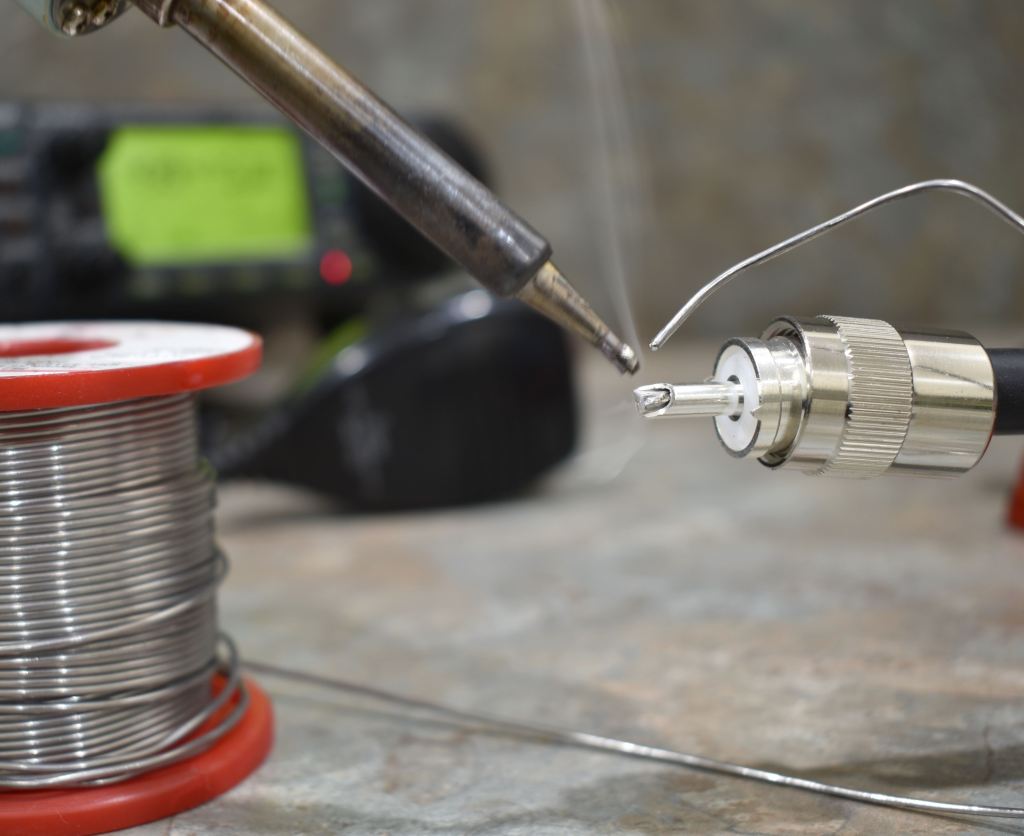
A loose coax plug can cause a high SWR and detune the output of a radio just as surely as a badly adjusted ATU or defective antenna. Ensure that connectors are fully tightened. When a low power carrier is transmitted via an SWR meter, operators can flex and shake coax connections to prove there are no SWR fluctuations. A poorly terminated coax braid or centre pin on a connector can also affect transmitter tuning.
Check your antenna
As with connectors, a corroded joint, cracked capacitor or poor termination in an antenna can result in transmitter instability through wild fluctuations in SWR. In extreme cases this can damage transmitter output stages.
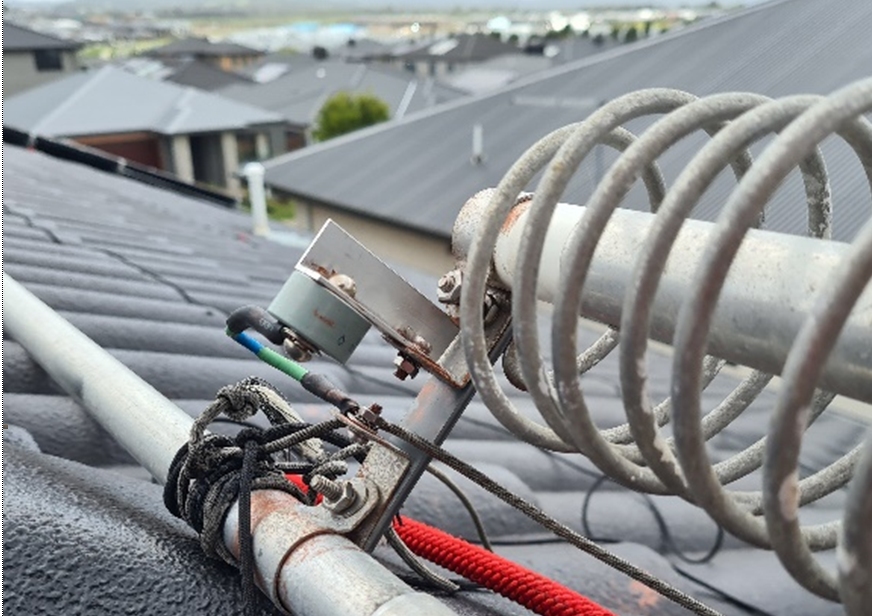
As with coax integrity checks, it is a good idea to look for fluctuations in SWR during transmissions on windy days.
The Foundation Level Study Guide
All Blue Tiles form part of the syllabus for the Foundation Level Recognition Certificate (operator licence). A primary source of information for many of the blue tile topics can be found within the Foundation Level Study Guide. This is a free download available at:
https://vkradioamateurs.org/flsg/ This is a digital book and contains many links to other resources and explanatory videos.
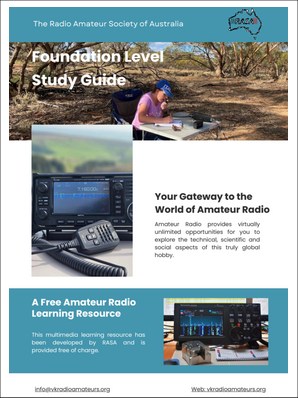
Information about using transmitters relevant to Foundation Level Qualifications can be found in this book from Chapter 4, on Pages 28
ACMA Syllabus Extract
According to the ACMA Foundation Syllabus, the required knowledge on this topic is:
4.2 Importance of proper transmitter adjustment
Recall that improper adjustment of a transmitter can cause harmful interference to other radiocommunications services, both inside and outside the frequency bands allocated to amateurs.
4.3 Emissions within Band limits
Recall that all components of transmitter emissions must be contained within the radiofrequency bands allocated to amateurs.
7.2 Interference to Other Services
Recall that interference to other radiocommunications services, including broadcast radio and television reception, can be caused by the faulty operation of radiocommunications transmitters.
7.3 Nearby Transmitters
Recall that radiocommunications transmitters can be the source (but not necessarily the cause) of interference to nearby electronic and radio equipment.
Recall that technical solutions can generally resolve the interference.
7.4 Interference and electromagnetic compatibility (EMC)
Recall that the ability of electronic or radio equipment to operate properly, without interference, in the presence of electromagnetic radiation, such as radiocommunications
transmissions, refers to the EMC of the equipment. This is also known as the equipment’s radiofrequency immunity.
7.5 Interference Pathways
Recall that radiocommunications transmissions that are the source of interference, may be induced into nearby electronic or radio equipment through conduction along electrical mains wiring or from direct pickup by the equipment.
7.6 Amateur Transmissions and EMC
Recall that interference resulting from EMC problems may be dependent on the power, frequency and type of emission of the radiocommunications transmitter and its distance from the affected equipment.
7.7 Antenna Location and EMC
Recall that interference resulting from EMC problems can be minimised by careful selection and siting of antennas.
7.8 Transmission Modes and Interference
Recall that some transmission modes are more likely than others to cause objectionable interference to broadcast radio and television reception and to telephones.
7.9 Filters
Recall that the immunity of most types of equipment can be increased by fitting suitable filters in external cabling, such as antenna, power supply or interconnections between equipment.
Recall that the filters should be fitted as close to the affected devices as possible.
7.10 Simple Choke Filter
Recall how to construct a simple RF ‘choke’ filter using a ferrite rod or toroid.
7.11 RF Earthing
Recall that the function of the RF earth connection in an amateur station is to provide a path to ground to minimise RF currents entering the mains earth system and causing interference to other electronic equipment.
Identify, from supplied diagrams, the symbol representing an earth connection.
7.12 Diplomacy and EMC
Recall that EMC problems have the potential for causing neighbourhood disputes. Understand the need for diplomacy, the sources of advice available and the role of the ACMA.
7.13 Harmful interference
Recall that a licensee must not operate an amateur station if its operation causes harmful interference to radiocommunication services.
 This Is Amateur Radio