
P71
Antenna Matching with a Balun
A Balun is a type of matching transformer that usually resides between an antenna and its feedline. They perform several important tasks, but to understand them it is first necessary to understand the difference between a Balanced feedline and an Un-Balanced feedline.

Unbalanced vs Balanced cables
Balanced feedlines have two wires above ground potential. Sometimes called Ladder-line’. This cable type is relatively high in impedance, between 300 and 600 ohms. The losses through this cable type are low, but it only works if there is some separation (100-200 mm) between the cable and any building or supporting structure.
Unbalanced Feedlines are referring to coaxial cable, where the signal is conveyed through the centre conductor and the outer shield is bonded to an earth connection.
Losses vary with the size and quality of the cable. The advantage is that it can be placed in close proximity to towers and metallic structures without compromising the cable impedance. Perfect for automotive installations.
This video clip provides a brief summary about these feedline types:
The Balun
You can’t just join an unbalanced coax cable to a balanced antenna (as shown in the folded dipole example below). It will work poorly. Apart from the probable impedance mismatch between the coax and the antenna type, the effect upon the symmetry and resonance of the antenna will be changed as the coax cable begins to become part of the antenna.
There needs to be a valid coupling method and correct impedance match for efficient power transfer from the transmitter to the antenna.

A device called a Balun (balanced-to-unbalanced) will do this for you. It is a form of transformer which adapts between balanced and unbalanced devices.
They can be made with different impedance conversion ratios. A 1:1 balun would have a 50 ohm Input impedance and a 50 ohm Output impedance
A 4:1 balun like the one shown below, would have a 200 ohm Input impedance and a 50 ohm Output impedance to the coax cable.

.
Internally, a balun is often a ferrite ring with an appropriate number of wire turns between its input and output. An advantage of this type of balun is that it works over a wide range of bands and frequencies.
Here is the 4:1 balun with its cover removed:
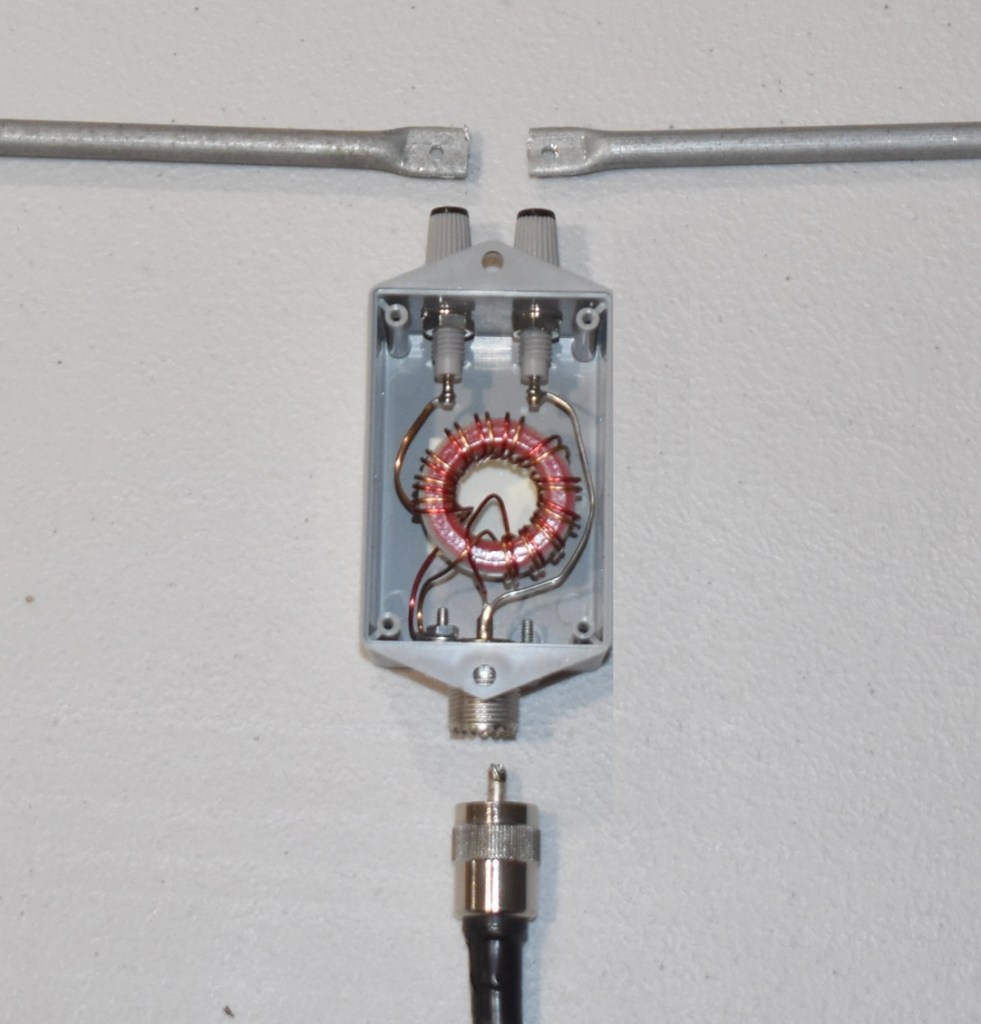
It is possible to make baluns with other methods. A loop of coax of the correct length and terminated can perform the same task, but then it is a frequency specific balun that will not work on other bands.
This beam antenna for 70cm has a 4:1 coax loop balun performing the same task as the toroidal version

The Foundation Level Study Guide
All Blue Tiles form part of the syllabus for the Foundation Level Recognition Certificate (operator licence). A primary source of information for many of the blue tile topics can be found within the Foundation Level Study Guide. This is a free download available at:
https://vkradioamateurs.org/flsg/ This is a digital book and contains many links to other resources and explanatory videos.

Information about baluns relevant to Foundation Level Qualifications can be found in this book from Chapter 5, on Pages 38 & 39
ACMA Syllabus Extract
According to the ACMA Foundation Syllabus, the required knowledge on this topic is:
5.1 Types of Transmission Lines
Identify from a supplied diagram, photograph or physical examples, common co-axial and balanced transmission lines. Recall their typical characteristic impedance.
5.13 Baluns
Recall that when feeding a balanced antenna with an unbalanced transmission line (co-axial cable), the preferred practice is to use a balun.
 This Is Amateur Radio