The Australian Amateur Band Plan – 23cm
The 23cm band is accessible to Standard and Advanced licence classes
- Transmission bandwidth is not limited
- Standard operators using emission modes J3E or R3E are limited to 100 watts pX
- Standard operators using other modes are limited to 30 watts pY
- Advanced operators using emission modes J3E or R3E are limited to 400 watts pX
- Advanced operators using other modes are limited to 120 watts pY
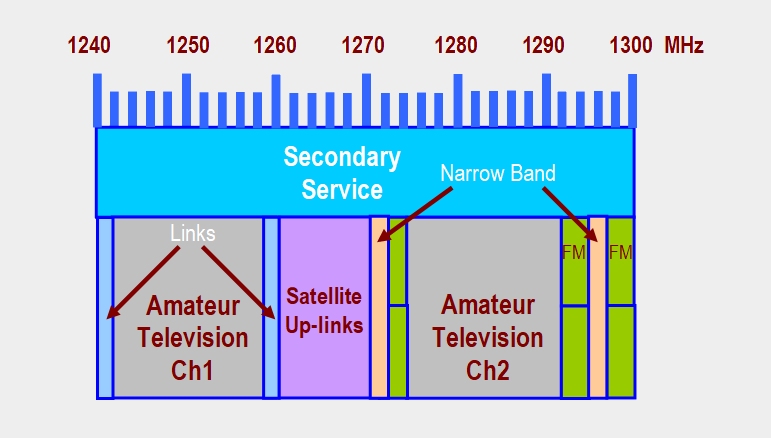
- 1.240 – 1.300 GHz is a Secondary Amateur Allocation
- 1.240 to 1.241 GHz is reserved for repeater links (Group A)
- 1.241 to 1.259 GHz is reserved for Amateur Television Channel 1 operation
- 1.259 to 1.260 GHz is reserved for repeater links (Group A)
- 1.260 to 1.270 GHz is reserved for Satellite up-link operation
- 1.270 to 1.272 GHz is available for narrow band modes
- 1.271 to 1.272 GHz is available for experimental activity
- 1.272.025 to 1.273 GHz is available for repeater links (Group B)
- 1.273.025 to 1.273.975 GHz is reserved for Repeater Outputs
- 1.274 to 1.292 GHz is reserved for Amateur Television Channel 2 operation
- 1.292.025 to 1.293 GHz is available for repeater links (Group B)
- 1.273.025 to 1.273.975 GHz is reserved for Repeater Inputs
- 1.293.025 to 1.293.975 GHz is available for FM repeater and Simplex operation
- 1.295 to 1.297 GHz is available for narrow band modes ( SSB/CW)
- 1.295.900 to 1.296.100 GHz is available for Earth-Moon-Earth (EME) operation
- 1.297.025 to 1.300 GHz is available for digital simplex modes.
- Repeater Notes
- Standard repeater offsets for 23cm is 20 MHz
- 91.5 Hz for CTCSS is the common repeater access tone
- Additional Notes
- FM simplex use 25 KHz channel spacing.
- Avoid terrestrial operation in the EME segment
- 1.250 GHz FM ATV Channel 1
- 1.250 GHz DVB ATV Channel 1
- 1.283 GHz FM ATV Channel 2
- 1.278 GHz DVB ATV Channel 2
 This Is Amateur Radio