The Australian Amateur Band Plan – 2M
The 2M band is accessible to all licence classes
- Transmission bandwidth has no limitations
- Foundation operators are limited in power output to 10 Watts pX
- Standard operators using emission modes J3E or R3E are limited to 100 watts pX
- Standard operators using other modes are limited to 30 watts pY
- Advanced operators using emission modes J3E or R3E are limited to 400 watts pX
- Advanced operators using other modes are limited to 120 watts pY
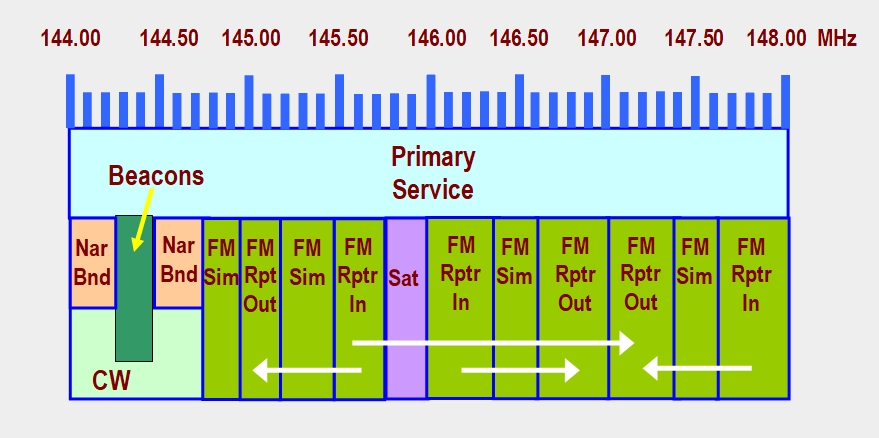
- 144.000 – 148.000 MHz is a Primary Amateur allocation
- 144.000 to 144.700 MHz is available for CW operation
- 144.000 to 144.100 MHz is available for Earth-Moon-Earth (EME) operation
- 144.110 to 144.160 MHz is also available for Earth-Moon-Earth (EME) operation
- 144.100 to 144.400 MHz is available for SSB operation
- 144.200 to 144.240 MHz is reserved for Digital DX operation
- 144.300 to 144.340 MHz is reserved for Space communications
- 144.400 to 144.600 MHz is reserved for Beacons
- 144.4904 to 144.4906 MHZ is reserved for WSPR operation
- 144.600 to 144.700 MHz is reserved for Experimental activity
- 144.700 to 144.900 MHz is reserved for Digital Simplex operation
- 144.925 to 145.050 MHz is reserved for Repeater Outputs
- 145.075 to 145.400 MHz is reserved for FM and Digital operation
- 145.400 to 145.775 MHz is reserved for Repeater Inputs
- 145.800 to 146.000 MHz is reserved for Satellite operation
- 146.0125 to 146.400 MHz is reserved for Repeater Inputs
- 146.425 to 146.600 MHz is reserved for FM Simplex operation
- 146.6125 to 147.000 MHz is reserved for Repeater Outputs
- 147.400 to 147.600 MHz is reserved for FM Simplex operation
- 147.6125 to 147.975 MHz is reserved for Repeater Inputs
Repeater Notes
- Standard repeater offsets for 2M is +/- 600 KHz
- 91.5 Hz for CTCSS is the common repeater access tone
- 141.3 or 146.2 Hz for CTCSS access to link other repeaters.
Additional Notes
- FM simplex use 25 KHz channel spacing.
- Digital voice Simplex modes (D-Star etc.) use 12.5 KHz channel spacing
- Avoid terrestrial operation in the EME segment
- 144.220 MHz – PSK & Slow CW
- 144.225 MHz – JT65
- 144.230 MHz – Meteor Scatter operation (3 KHz bandwidth max)
- 144.300 MHZ – General SSB call freq.
- 144.489 MHz – WSPR
- 145.100 MHz – Non voice operation, RTTY, SSTV
- 145.175 MHz – APRS
- 145.300 MHz – ARDF operations
- 145.650 MHz – CW practise beacons, VK2, VK3
- 145.700 MHz – ARDF Beacons
- 146.500 MHz – General FM call freq.
- 147.400 MHz – ATV Liasion
- 147.175 MHz – WICEN repeaters
 This Is Amateur Radio