The Australian Amateur Band Plan – 6M
The 6M band is accessible to Standard and Advanced licence class only
- Transmission bandwidth should not exceed 100 KHz
- Standard operators using emission modes J3E or R3E are limited to 100 watts pX
- Standard operators using other modes are limited to 30 watts pY
- Advanced operators using emission modes J3E or R3E are limited to 400 watts pX
- Advanced operators using other modes are limited to 120 watts pY
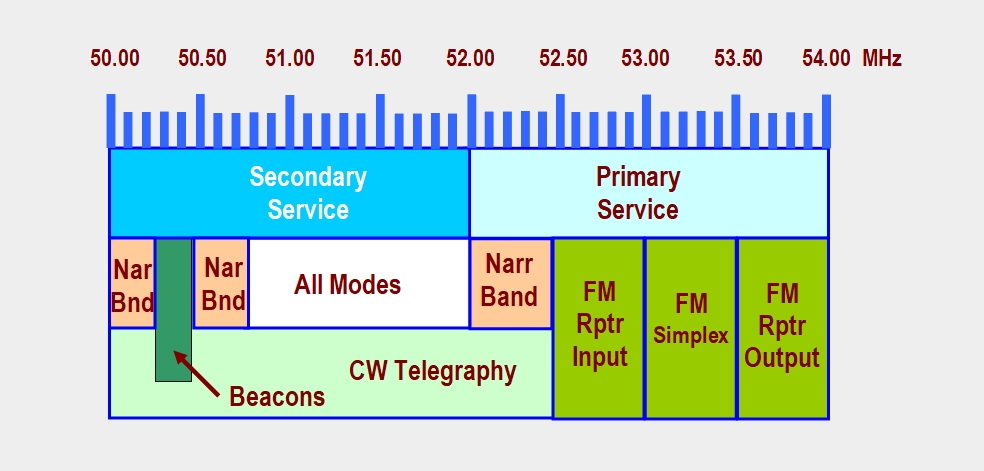
- 50.000 – 52.000 MHz is a Secondary Amateur allocation
- 52.000 – 54.000 MHz is a Primary Amateur Allocation
- 50.000 to 52.500 MHz is available for CW operation
- 50.000 to 50.700 MHz Narrow band modes, CW and Digital
- 50.000 to 50.080 MHz International Beacons
- 50.280 to 50.299 MHz Beacons VK1, VK2, VK3, VK4, VK7
- 50.300 to 50.320 MHz Beacons VK5, VK6, VK8, VK9, VK0
- 50.700 to 52.000 MHz is available for AM/FM/SSB operation
- 52.000 to 52.500 MHz Narrow band modes, CW and Digital
- 52.500. to 53.000 MHz is available for Narrow band FM Repeater Inputs (1 MHz offsets)
- 53.000. to 53.500 MHz is available for Narrow band FM Simplex, 25 KHz channel spacing
- 53.500. to 54.000 MHz is available for Narrow band FM Repeater Outputs
Additional notes:
- 50.110 MHz – General call freq.
- 50.200 MHz – International DX call freq.
- 50.313 MHz – FT8
- 50.220 MHz – PSK
- 50.310 MHz – JT65
- 50.312 MHz – JT9
- 50.293 MHz – WSPR
- 53.050 MHZ – APRS
 This Is Amateur Radio